10 Singapore Math Games for Kindergarten (No Prep)
10 no-prep math games for K1-K2 kids — counting, addition, shapes and patterns, aligned to Singapore's NEL framework. No worksheets needed.
QuizKin Team
Published 26 April 2026
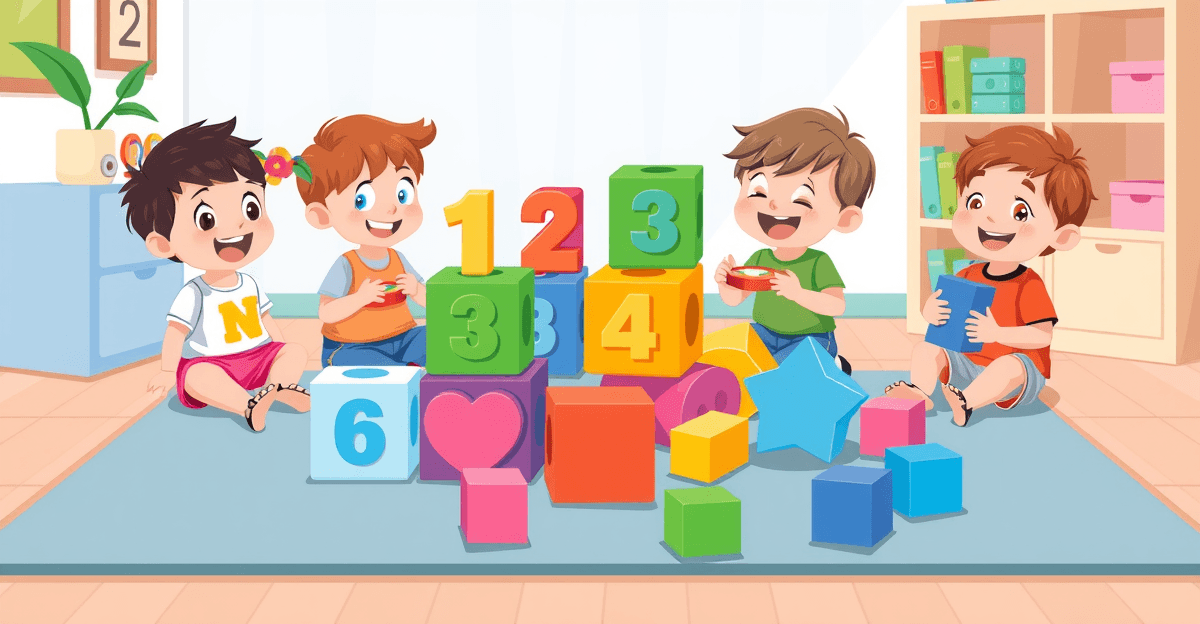
Most Singapore parents are laser-focused on reading and phonics with their preschooler — and honestly, fair enough. But math? That one tends to sneak up on you. Then Primary 1 arrives and suddenly the school expects your child to already have solid number sense, and you're wondering when that was supposed to happen.
TL;DR: Fun, no-prep math games for K1-K2 kids at home. Build number sense, counting, addition, shapes, and patterns with activities aligned to the Singapore MOE NEL framework.
Here's the thing though — building kindergarten math skills doesn't require worksheets, tuition centres, or expensive enrichment classes. The games below use everyday household items and take five to fifteen minutes each. They're aligned with the MOE NEL framework Numeracy learning area, so everything your child practises feeds directly into what they'll learn at school. Win-win.
Why Early Math Matters More Than You Think
A University of Chicago study found something pretty striking: a child's math skills at kindergarten entry are the single strongest predictor of later academic achievement. Stronger than reading skills. Stronger than attention span. Kids who start Primary 1 with a solid grasp of numbers, shapes, and patterns consistently outperform their peers all the way through Primary 3 and beyond.
In Singapore, the MOE NEL framework identifies Numeracy as one of the six core learning areas for preschool. By K2, children are expected to count to at least 30, recognise and write numerals, compare quantities, identify shapes, and understand simple patterns. It's a real foundation — not fluff.
Game 1: The Supermarket Challenge
What it builds: Counting, one-to-one correspondence, estimation
Game 1 became a weekly ritual at NTUC FairPrice for us — and the best part is it costs nothing extra. Next time you're grocery shopping, give your child a simple mission: "Can you put exactly 5 apples in the bag?" or "How many eggs are in this carton?" For older K2 children, level it up with estimation: "Do you think there are more than 10 oranges on this shelf?"
This works because it connects numbers to real, physical objects. Your child isn't counting pictures on a laminated card — they're counting actual apples with weight and texture and the whole sensory experience that makes learning stick.
Game 2: Dice Wars
What it builds: Subitising (instant number recognition), comparison
My daughter demanded Dice Wars at every family dinner for about three months straight. The rules are dead simple: each player rolls a die, whoever rolls higher wins that round, first to 10 wins. For K2 children, use two dice and add the numbers together.
The skill this targets — subitising, which means recognising a quantity instantly without counting each dot — is foundational and wildly underrated. Most parents have never even heard the word, but regular dice play builds it naturally. By the end of our Dice Wars phase, my daughter could look at a 6 on the die and just know it was 6 without a second glance.
Game 3: Shape Hunt
What it builds: 2D and 3D shape recognition, vocabulary
Walk around your home together and hunt for as many examples of each shape as you can spot. Circles: clock, plate, coin. Rectangles: door, book, phone. Triangles: coat hanger, sandwich cut diagonally, that triangular outline of a neighbour's roof.
For K2 children, push into 3D shapes: the fridge is a rectangular prism, a ball is a sphere, a Pringles can is a cylinder. (Fair warning — once your child learns "cylinder," they will correct you every single time you call it a can.)
Game 4: Pattern Trains
What it builds: Pattern recognition, prediction, logical thinking
Grab some coloured blocks, LEGO bricks, or even a row of fruit and lay out a pattern: red-blue-red-blue. Ask your child what comes next. Start simple with AB patterns, then graduate to ABC, AAB, and AABB as confidence builds.
Pattern recognition is essentially the foundation of algebraic thinking, which sounds intimidating but isn't — it just means your child learns to see structure in the world. Kids who can spot and extend patterns in K2 find Primary 1 math dramatically easier. This one's worth spending time on.
Game 5: Measuring With Hands and Feet
What it builds: Non-standard measurement, comparison, estimation
"How many hand-spans wide is the dining table?" "How many of your footsteps is it from the bedroom to the kitchen?" These are the kinds of questions that make a five-year-old feel like a proper scientist.
This introduces measurement concepts without rulers or centimetres, which is exactly what the NEL framework recommends at this age. Then push into comparison: "The sofa is 8 hand-spans but the table is only 5. Which one is longer?" You'll be surprised how much a child can reason through when it's framed the right way.
Game 6: The Coin Sorting Game
What it builds: Sorting, classification, early money concepts
Empty out a coin jar and let your child loose on it. Sort by size, by colour, by value — whatever attribute they want to try first. For K2 children, introduce basic money concepts: "If this toy costs 50 cents, which coins could we use to pay?"
There's something about real coins that genuinely excites kids in a way plastic play money never quite does. And practically speaking, the tuckshop at primary school is coming faster than you think — handling money confidently is a life skill that starts here.
Game 7: Building Block Towers
What it builds: Counting, comparison, addition, spatial reasoning
Build two towers side by side. Count the blocks in each. Which tower has more? How many more blocks does it have? For K2 children, make it dynamic: "If we move 2 blocks from this tower to that one, how many does each tower have now?"
What you're doing here is concrete addition and subtraction — the child can physically pick up the block, move it, and recount. That physical manipulation is what makes the abstract concept actually land. Worksheets can wait.
Game 8: Number Line Hopscotch
What it builds: Number sequence, forward and backward counting
Grab some chalk and head to your void deck. Draw a number line from 1 to 10 (or 1 to 20 for confident counters). Call out a number and have your child jump to it. Then try directions: "Jump forward 3 spaces!" or "Jump back 2!" The movement, the counting, the outdoor air — it all works together.
This builds the mental number line that children rely on when they start doing addition and subtraction in their heads. It's a surprisingly important foundation, and it doubles as a reason to get off the screen for twenty minutes.
Game 9: Story Problems at Dinner
What it builds: Word problem comprehension, mental arithmetic
Dinner table math is low-effort and genuinely effective. "There are 4 of us at the table and everyone needs a fork — how many forks do we need?" "You have 3 nuggets and I give you 2 more. Now how many do you have?"
This embeds math into the flow of daily life, which sends a powerful message: numbers aren't just for school. They're everywhere. Children who grow up treating math as part of normal conversation tend to approach word problems in school with far less anxiety.
Game 10: QuizKin Adaptive Math Quizzes
What it builds: Number recognition, counting, shapes, patterns, colours
For structured practice that slots in between all the hands-on games, QuizKin's adaptive quizzes cover every numeracy skill above with questions that automatically adjust to your child's level. The app figures out which concepts your child finds tricky and builds targeted revision sessions around those specific gaps.
It's genuinely different from worksheets, which just present the same difficulty regardless of where your child actually is. Adaptive learning meets kids where they are — challenging enough to push growth, easy enough that they stay confident and keep going.
How to Know If Your Child Is On Track
Here's a rough guide based on MOE NEL framework expectations — not a stress test, just a useful reference:
K1 (age 4-5): Count to 20, recognise numerals 1-10, name basic shapes, sort by one attribute, copy simple patterns.
K2 (age 5-6): Count to 30+, write numerals 1-10, compare quantities using more/less/equal, identify 2D and 3D shapes, extend patterns, simple addition and subtraction with objects.
If your child isn't hitting every milestone on this list, honestly — don't spiral. Consistent daily practice, even just 10 minutes, closes gaps remarkably fast at this age. The brain is doing incredible things between 4 and 6.
The Bottom Line
Kindergarten math doesn't need to feel like school. The best learning at this age happens when children have no idea they're learning — when counting is a game, shapes are a treasure hunt, patterns are a puzzle, and the dinner table is basically a math classroom nobody signed up for.
Pick one or two games from this list to start. Rotate weekly so it stays fresh. And pair the hands-on play with QuizKin's adaptive quizzes for a balanced approach that covers all the key concepts your child needs before Primary 1. You've got this.
Sources
Looking for more? Check out find a tutor for free on TuitionLah.
Exploring parenthood in Singapore? Visit ParentLah for practical tips on raising kids in Singapore.
Practise what you’ve read with QuizKin
Adaptive quizzes covering phonics, sight words, numbers, and more — aligned with the Singapore MOE curriculum. Start your free Premium trial today.
Frequently Asked Questions
By the end of K1, most Singapore children can count to at least 20, recognise written numerals 1-10, compare quantities using 'more' and 'less', identify basic 2D shapes (circle, square, triangle, rectangle), and sort objects by one attribute such as colour or size. These skills are part of the MOE NEL framework Numeracy learning area.
Use games, not worksheets. Incorporate counting into daily routines like setting the table or climbing stairs. Play dice games, use building blocks for shapes, and let your child handle real coins at the supermarket. The key is to make math feel like play rather than study.
K2 children can begin simple addition and subtraction with concrete objects — for example, combining two groups of blocks and counting the total. Avoid abstract written sums at this stage. Focus on building strong number sense and one-to-one correspondence first, which makes formal arithmetic much easier in Primary 1.
Yes. QuizKin covers number recognition, counting, shapes, colours, and patterns with adaptive quizzes that adjust to your child's level. The app tracks which concepts your child finds difficult and automatically creates revision sessions targeting those areas.
Ready to make learning fun?
QuizKin turns screen time into learning time with adaptive quizzes built for K1-K2 kids in Singapore. Free to start.
Related Articles

Teach Your Child to Read at Home (Singapore Guide)
Help your K1-K2 child read independently at home. From phonics and sight words to building fluency, aligned with the Singapore MOE kindergarten curriculum.
Addition & Subtraction for Preschoolers Singapore
Hands-on ways to teach addition and subtraction to K1-K2 kids with Singapore's CPA approach — concrete activities, common mistakes, weekly play plan.
The 15-Minute After-School Learning Routine for K1 & K2 Kids (Singapore)
A practical daily routine for reinforcing kindergarten learning at home. 15 minutes of phonics, sight words, and writing practice that Singapore parents can start today.