Executive Function Skills in Preschoolers: Why They Matter
Executive function skills in preschoolers shape focus, memory & self-control. A Singapore parent's guide to building them in K1-K2 kids before Primary 1.
Mervin Tan · Founder, QuizKin
Published 30 June 2026
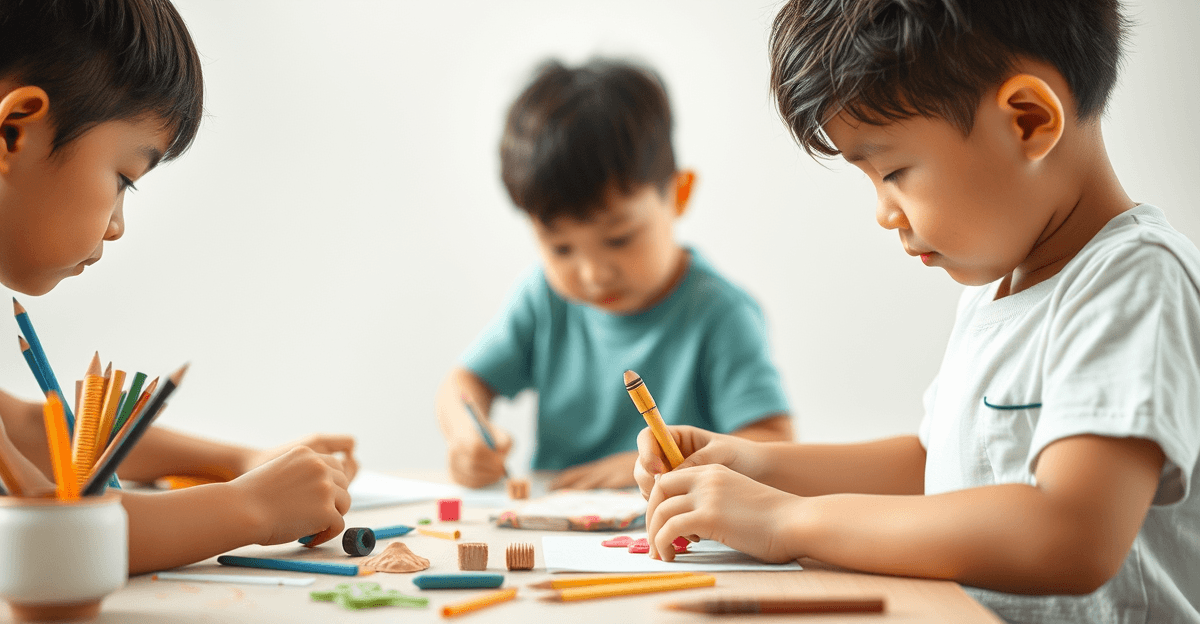
Your little one can recite the whole alphabet and count to 100 — but still melts down when it's time to switch from playing to packing up, or forgets the second half of "put on your shoes and grab your water bottle." Sound familiar? You're not looking at a discipline problem. You're watching executive function skills in preschoolers still under construction. These are the mental management skills — focus, memory, and self-control — that help your child plan, wait, remember instructions, and bounce back from frustration. For Singapore parents preparing a K1 or K2 child for Primary 1, these skills quietly matter more than knowing extra spelling words.
🧠 Key Takeaway
Executive function is the brain's "air traffic control system" — it manages attention, working memory, and self-control. These skills develop fastest between ages 3 and 6, predict school success better than IQ, and can be strengthened at home through everyday play. For K1-K2 children in Singapore, building executive function now sets up a smoother, calmer transition to Primary 1.
What Are Executive Function Skills in Preschoolers?
Executive function skills in preschoolers are the set of mental processes that let a child control impulses, hold information in mind, and adapt to change. Child development researchers group them into three core areas: working memory, inhibitory control (self-control), and cognitive flexibility. Together they act like the brain's air traffic control system, managing many "flights" of thought without crashes.
Here's what each looks like in a 4-6 year old:
- Working memory — holding instructions or ideas in mind while using them. Example: remembering both steps when you say "wash your hands, then come to the table."
- Inhibitory control — pausing before acting. Example: waiting for a turn on the slide instead of pushing ahead, or raising a hand instead of shouting out.
- Cognitive flexibility — shifting between rules or perspectives. Example: sorting blocks by colour, then switching to sorting them by shape without getting stuck.
Definitive point: According to Harvard's Center on the Developing Child, no one is born with executive function skills — every child is born with the potential to develop them, and the environment they grow up in determines how strong that foundation becomes. That's empowering news for parents: this is a skill set you can actively nurture, not a fixed trait your child either has or doesn't.
Why Do Executive Function Skills Matter So Much for K1-K2 Kids?
Strong executive function skills in preschoolers predict academic success, social ability, and emotional well-being for years to come. Studies tracking children over time have found that early self-control predicts later school grades — sometimes more reliably than IQ scores do. For Singapore families, that means executive function deserves a place alongside literacy and numeracy on your radar.
Consider what a typical Primary 1 morning in Singapore demands of a six-year-old:
- Unpack their bag and find the right book — working memory and planning.
- Sit through a 30-minute lesson without wandering off — inhibitory control and sustained attention.
- Follow "open page 12, write your name, then start question one" — multi-step working memory.
- Move from English to Maths and switch mental gears — cognitive flexibility.
A child who reads beautifully but cannot manage these self-regulation demands will struggle far more than parents expect. This is why MOE's Nurturing Early Learners (NEL) framework — used across PCF Sparkletots, My First Skool, and PAP Community Foundation kindergartens — emphasises learning dispositions like perseverance, engagement, and self-management, not just academic content. The MOE Kindergarten curriculum deliberately builds these "soft" skills because they underpin everything else.
It also explains why a child with shaky executive function can experience more stress during assessments and new situations. If you've noticed nerves creeping in before a class test or a new-school visit, our guide on Reducing Test Anxiety in Preschoolers pairs naturally with the strategies below.
How Do Executive Function Skills Develop in Young Children?
Executive function develops fastest between ages 3 and 6, then continues maturing all the way into a person's mid-20s. The preschool years are a critical window because the brain's prefrontal cortex — the region behind these skills — is growing rapidly. This is why K1 and K2 are such a golden opportunity for Singapore parents.
Realistic milestones to expect:
| Age | What executive function typically looks like |
|---|---|
| 3-4 (Nursery/K1) | Follows one-step instructions; waits very briefly; needs help switching activities |
| 4-5 (K1) | Holds two simple steps in mind; takes turns with reminders; manages short waits |
| 5-6 (K2) | Follows two-to-three step instructions; controls impulses better; adapts to changed rules; plans simple tasks |
Remember: these are averages, not deadlines. Some children sprint ahead in working memory but need more support with self-control — that's completely normal. Development is uneven, and a wobble in one area doesn't predict the whole picture. The goal at home is steady practice in a warm, low-pressure environment, because chronic stress actually weakens executive function development.
7 Everyday Ways to Build Executive Function at Home
You don't need flashcards or expensive programmes to strengthen executive function skills in preschoolers — the best tools are play, routine, and your everyday interactions. Research from Harvard shows that age-appropriate games and predictable routines are among the most effective ways to build these skills. Here are seven that fit naturally into a busy Singapore household:
1. Play classic self-control games
"Simon Says," "Red Light, Green Light," and freeze-dance all train inhibitory control — the child has to stop an impulse and follow a rule. Just 10 minutes counts.
2. Use "first-then" language for transitions
Instead of a sudden "Time to go!", try "First we keep the blocks, then we go to the playground." This builds planning and eases the transitions that so often trigger meltdowns.
3. Give two-step instructions on purpose
"Please put your cup in the sink and bring me your shoes." Gradually stretching to two and three steps is direct working-memory exercise. Praise the effort, not just the result.
4. Cook or bake together
Following a simple recipe — measure, pour, stir, wait — is a full executive-function workout disguised as a fun afternoon. It also sneaks in maths and sequencing.
5. Play matching, memory, and sorting games
Card-matching games and sorting toys by colour-then-shape build working memory and cognitive flexibility. These same skills feed directly into early numeracy — see what's coming in our K2 Maths Assessment guide.
6. Protect pretend play
Imaginative role-play ("let's run a hawker stall") requires children to hold a storyline in mind, take on roles, and follow self-made rules — rich executive-function territory. Building these social-cognitive muscles also supports developing social skills in preschoolers.
7. Use short, well-designed learning games
Quality matters more than quantity here. Well-structured digital practice that asks your child to focus, remember a rule, and adapt to a new question type can reinforce the very skills above — when it's purposeful and time-limited.
This is where thoughtful tools help. QuizKin offers adaptive quiz practice that makes learning fun and measurable for K1-K2 kids — questions adjust to your child's level, so they stay in that sweet spot of "challenging but achievable" that builds focus and persistence rather than frustration. Because it's game-based, it taps into why game-based learning works so well for preschoolers, while a short daily session keeps screen use intentional. If you're mapping out your family's screen rules, our Screen Time Rules for Preschoolers guide offers healthy, realistic limits.
Executive Function and Primary 1 Readiness in Singapore
Executive function is one of the strongest predictors of how smoothly a child settles into Primary 1 — often more important than how many words they can read on day one. A child who can self-regulate, remember instructions, and recover from small setbacks will adapt to a larger class and reduced adult support far more easily than one who can't.
Fine motor control, attention, and self-management all work together during the P1 transition. Strengthening little hands through purposeful play supports the focus side of the equation too — our Fine Motor Skills Activities for K1 Kids article complements this nicely. And if you want the full picture of what schools look for, the Primary 1 Readiness 30-Skills Checklist maps executive function alongside literacy, numeracy, and independence.
If you feel your child would benefit from more structured support before P1 — especially with focus and routine — a patient tutor can make a real difference. You can find one without agency fees through TuitionLah, the publisher's free tutor-matching service.
Definitive point: Decades of developmental research converge on a clear message — investing in your child's self-regulation and working memory during the preschool years pays larger long-term dividends than pushing academic content too early. Calm, confident, focused learners thrive in Singapore's classrooms.
When Should I Be Concerned About My Child's Executive Function?
Occasional forgetfulness, impulsiveness, and meltdowns are completely normal in 4-6 year olds — executive function is still years from being fully developed. Concern is warranted only when difficulties are severe, persistent, and present across many settings (home, preschool, grandparents' place), and clearly out of step with same-age peers.
Watch for patterns like:
- Consistently unable to follow even one-step instructions by K2
- Extreme, frequent meltdowns over routine transitions
- Significant trouble with attention that affects daily learning and play everywhere
If several of these ring true, start by chatting with your preschool teacher, who sees your child alongside many peers. You can also seek a developmental assessment through KK Women's and Children's Hospital (KKH) or the National University Hospital (NUH). Early support is highly effective — and the goal is always encouragement, never labels.
The Bottom Line for Singapore Parents
Executive function skills in preschoolers — focus, working memory, and self-control — are the quiet foundation beneath every other skill your child is building during K1 and K2. They predict school success, smooth the leap to Primary 1, and grow best through warm routines, playful games, and gentle daily practice rather than pressure. Your little one doesn't need to be perfect; they need a patient guide and plenty of chances to practise.
The good news? You're already doing it — every "first-then," every game of Simon Says, every two-step instruction is a brick in that foundation. Keep it light, keep it consistent, and trust the process.
Looking for more learning tools and family activity deals to keep things fun? Browse the latest education offers on WhyNotDeals.
Sources
- Harvard Center on the Developing Child — Executive Function & Self-Regulation — research overview on how executive function develops in early childhood.
- MOE Nurturing Early Learners (NEL) Kindergarten Curriculum Framework — Singapore's official preschool curriculum, including learning dispositions and self-management.
- HealthHub Singapore — Child Development & Milestones — government health portal on developmental milestones for young children.
- KK Women's and Children's Hospital — Child Development Service — local clinical resource for developmental assessment and support.
- MOE — Preparing for Primary School — official guidance on the transition into Primary 1 in Singapore.
Practise what you’ve read with QuizKin
Adaptive quizzes covering phonics, sight words, numbers, and more — aligned with the Singapore MOE curriculum. Start your free Premium trial today.
Frequently Asked Questions
Executive function skills begin developing in infancy but grow most rapidly between ages 3 and 6 — exactly the K1-K2 years in Singapore. By age 5, most children can hold two simple instructions in mind and wait a short turn. These skills are not fully mature until the mid-20s, so K1-K2 is about building foundations, not perfection. Patience and daily practice matter more than drilling.
Common signs in preschoolers include trouble following two-step instructions, frequent meltdowns when transitioning between activities, difficulty waiting their turn, and losing track of what they were doing. Occasional struggles are completely normal at ages 4-6. If your child consistently lags far behind peers across many settings, speak to your preschool teacher or a KKH/NUH developmental clinic for guidance.
Yes — research consistently shows executive function predicts early school success better than IQ. In Singapore's Primary 1 setting, children must sit, follow multi-step instructions, manage their own belongings, and stay on task with less adult support. Strong self-regulation and working memory make this transition far smoother. Building these skills in K2 is one of the best investments you can make.
About the author
Mervin Tan
Founder, QuizKin
Mervin Tan is the founder of QuizKin and a software engineer and dad of two young children in Singapore. He builds QuizKin's adaptive quiz engine and writes practical K1-K2 learning guides grounded in MOE's Nurturing Early Learners framework and his own experience preparing his kids for Primary 1. QuizKin is built by Adaptels Pte. Ltd., Singapore.
Ready to make learning fun?
QuizKin turns screen time into learning time with adaptive quizzes built for K1-K2 kids in Singapore. Free to start.
Related Articles
Self-Regulation Skills for K1-K2: Managing Big Emotions
Help your K1-K2 child build self-regulation skills to manage big emotions. A warm, evidence-based guide for Singapore parents of 4-6 year olds.
Sensory Processing in Preschoolers: Singapore Parent Guide
A warm, evidence-based guide to sensory processing in preschoolers for Singapore parents of K1-K2 kids — signs, activities, and when to seek help (ages 4-6).
Creating the Perfect Home Learning Environment
Learn how to create the perfect home learning environment for your K1-K2 child in Singapore. Practical, space-saving tips to boost focus and school readiness.