Fostering Creativity in Young Children Beyond Art Class
Practical ways to foster creativity in young children beyond art class. A Singapore parents' guide to nurturing imagination in K1-K2 kids aged 4-6.
QuizKin Team
Published 14 September 2026
This article contains affiliate links — if you buy through them, QuizKin may earn a small commission at no extra cost to you. We only link products relevant to the activity.
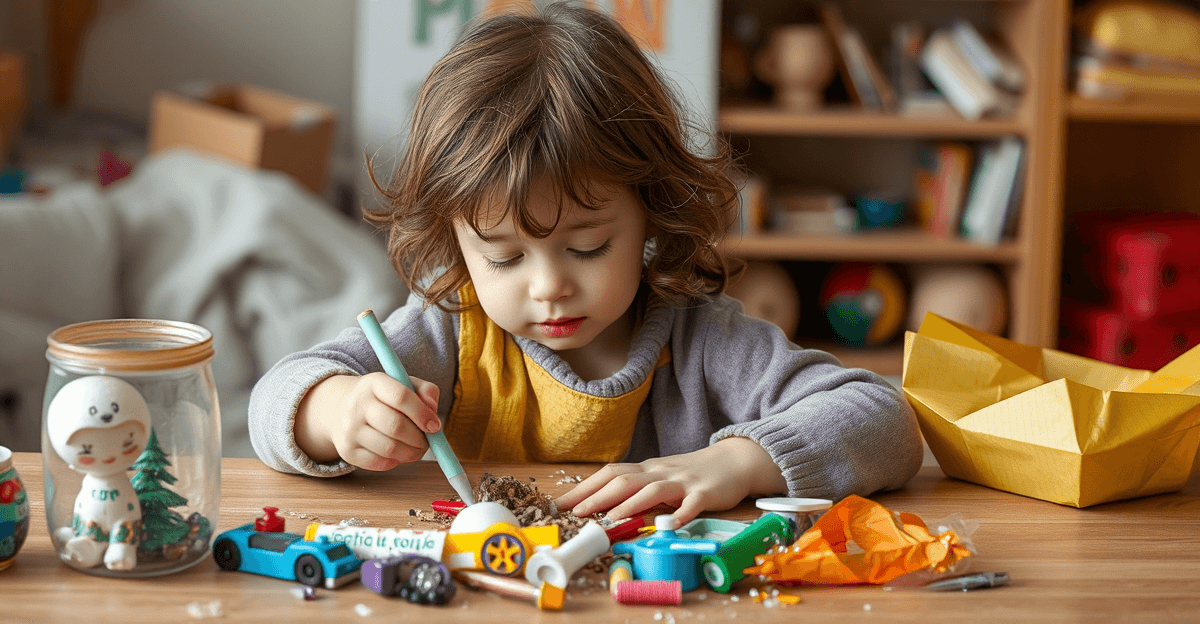
Your little one comes home from preschool clutching a painting of a purple elephant with six legs. You praise it, stick it on the fridge, and quietly wonder: is one art class a week actually enough to nurture a creative mind? For many Singapore parents, fostering creativity in young children feels like something that only happens during a scheduled enrichment slot — art, music, or the occasional drama class. But creativity is far bigger than any single activity, and the good news is that the most effective ways to grow it cost nothing and happen right at your kitchen table.
Creativity in the early years is not about producing pretty artwork. It is about how your child thinks — the ability to ask questions, imagine possibilities, try new approaches, and bounce back when something doesn't work. These are the exact thinking skills that will serve your child through primary school and beyond, long after the crayons are packed away.
TL;DR — Key Takeaways
- Creativity is a thinking skill, not an artistic talent — it can be nurtured all day, every day, not just in art class.
- Ages 4-6 (K1-K2) are a peak window for imaginative play; MOE's own framework prioritises exploration over rote learning.
- The four biggest creativity boosters at home are: open-ended questions, unstructured play, tolerance for "boredom", and process-focused praise.
- Screen time isn't the enemy — passive screen time is. Interactive, purposeful learning tools can support creative thinking within a 1-hour daily limit.
- You do not need to spend money on more classes. Everyday moments matter most.
Why Fostering Creativity in Young Children Matters More Than You Think
Creativity is one of the strongest predictors of problem-solving ability later in life, and the preschool years are when it develops fastest. Between ages 3 and 6, children engage in more imaginative pretend play than at any other stage — a natural creativity engine that parents can either fuel or accidentally shut down. Fostering creativity in young children during this window builds the cognitive flexibility that supports reading, maths, and social reasoning.
Here is a definitive point worth remembering: creativity is not the opposite of academic success — it underpins it. A child who can imagine multiple ways to solve a puzzle is the same child who will later approach a tricky maths word problem from several angles. The Ministry of Education's Nurturing Early Learners (NEL) framework, which guides kindergarten curricula across Singapore — including PCF Sparkletots, My First Skool, and PAP Community Foundation centres — explicitly lists "aesthetics and creative expression" and "discovery of the world" among its six core learning areas. In other words, MOE already treats creativity as foundational, not optional.
Yet in Singapore's understandably results-focused culture, many parents worry that time spent "just playing" is time lost. The evidence points the other way. Play is the work of early childhood, and unstructured, child-led play is where divergent thinking — the ability to generate many different ideas — is exercised most.
Creativity vs. Artistic Talent: An Important Difference
Parents often confuse the two. Artistic talent is the ability to draw, paint, or perform well. Creativity is the ability to generate original ideas and combine them in useful ways — and it shows up in maths, storytelling, building with blocks, and even how your child negotiates whose turn it is on the slide. Your child does not need to be "good at art" to be deeply creative.
How to Foster Creativity Beyond Art Class: 6 Everyday Strategies
The most effective way to build a creative child is to weave small habits into ordinary days rather than adding another class to an already-packed schedule. Research on early childhood consistently shows that everyday interactions with parents shape creative thinking more than any single structured programme. Below are six evidence-based strategies you can start today.
1. Ask Open-Ended Questions Instead of Yes/No Ones
Questions with no single correct answer stretch your child's imagination. Swap "Did you have fun today?" for "What was the most surprising thing that happened today?" or "If your toy could talk, what would it say?"
A simple rule: aim for questions that begin with what if, how might, or why do you think. These invite your child to generate ideas rather than retrieve a fact. Try "How many uses can you think of for this cardboard box?" — a classic divergent-thinking prompt that children as young as four genuinely enjoy.
2. Protect Unstructured, Screen-Free Play
Free play — the kind with no rules, no adult direction, and no correct outcome — is the single richest source of creativity in early childhood. When your child turns the sofa cushions into a pirate ship, they are practising planning, storytelling, and flexible thinking all at once.
Aim to protect at least an hour of unstructured play daily, ideally including some outdoor time. Open-ended materials matter more than expensive toys: blocks, cardboard, water, sand, dress-up clothes, and loose parts (buttons, sticks, fabric) invite far more invention than a single-function electronic toy — grab a mix of these on Shopee for next to nothing. If you're looking to develop the hand strength that supports this kind of hands-on play, our guide to fine motor skills activities for K1 kids pairs perfectly with open-ended building.
3. Let Your Child Be Bored
This one surprises many parents. Boredom is uncomfortable, and the instinct is to fill it — with a screen, a snack, or a suggestion. But boredom is the doorway to imagination. When a child has nothing to do, their mind eventually starts to invent something.
The definitive takeaway here: a bored child is a child on the verge of a creative idea — resist the urge to rescue them too quickly. Give it a few minutes. You'll often see them drift into elaborate pretend play on their own.
4. Praise the Process, Not Just the Product
How you respond to your child's efforts shapes whether they keep taking creative risks. Praising the outcome ("What a beautiful drawing!") teaches children to seek approval. Praising the process ("I love how you tried mixing those two colours to see what happened") teaches them that experimenting is valuable in itself.
Process praise builds a growth mindset — the belief that ability grows with effort. Children who develop this mindset are more willing to attempt hard, uncertain, creative tasks, which matters enormously as they approach the more demanding K2 maths assessments and, eventually, Primary 1.
5. Model Curiosity Yourself
Children learn creativity by watching the adults around them. When you say "I don't know — let's find out together" or wonder aloud about how something works, you show your little one that not-knowing is exciting rather than threatening. Cook a new recipe together, take apart a broken torch, or make up a silly song on the drive home. Your willingness to experiment gives your child permission to do the same.
6. Combine Structured Learning With Room to Explore
Structure and creativity are not enemies. In fact, a little foundational knowledge gives children more raw material to be creative with — you can only imagine new stories if you have words, and you can only invent number games if you understand quantities. The key is keeping structured learning light, playful, and confidence-building rather than pressured.
This is where thoughtful digital tools can help. QuizKin offers adaptive quiz practice that makes learning fun and measurable for K1-K2 kids, adjusting to your child's level so they stay in that sweet spot of "challenged but not frustrated." Building a strong, secure base in letters, numbers, and concepts frees up your child's mental energy for the imaginative leaps that creativity requires. If you want to understand why the game-based approach works so well at this age, see our deep-dive on why gamified learning works for preschoolers.
Does Screen Time Help or Hurt Creativity?
Screen time gets a bad reputation, but the type of screen use matters far more than the total minutes. Passive, fast-paced content can crowd out the boredom and free play that spark imagination, while interactive, purposeful learning can genuinely support development. Singapore's Ministry of Health recommends no more than one hour of quality screen time per day for children aged 2 to 6, and none for those under 18 months.
The practical distinction: lean-back screen time (endless videos, autoplay) tends to reduce creative play, while lean-forward screen time (creating, drawing, solving, building) can complement it. An adaptive learning quiz your child actively engages with for 15 focused minutes is a very different experience from an hour of passive scrolling. For a full framework on setting healthy limits, read our screen time rules for preschoolers, and if you're comparing tools, our roundup of the best educational apps for 4-year-olds in Singapore is a useful starting point.
How Does Creativity Connect to Primary 1 Readiness?
Creativity and school readiness are not competing goals — they reinforce each other. Creative children tend to be more curious, more resilient when they get something wrong, and more flexible in how they approach new tasks, all of which ease the transition to Primary 1. The problem-solving and self-expression skills nurtured in the preschool years show up directly in the Primary 1 classroom.
Consider how creativity supports each readiness area: storytelling builds the vocabulary and sequencing needed for English; imaginative block play builds the spatial reasoning behind maths; and pretend play with peers builds the negotiation and turn-taking that underpin classroom social skills. If you want a concrete list of what to aim for, our Primary 1 readiness checklist maps out 30 specific skills across these domains.
One more reassuring point for anxious parents: nurturing creativity actually reduces pressure. Children who feel free to explore and make mistakes are less likely to develop performance anxiety — a growing concern that we cover in reducing test anxiety in preschoolers. A creative, low-pressure home is one of the best protections against early academic stress.
Simple Creativity-Boosting Activities You Can Try This Week
You don't need a Pinterest board or a craft cupboard. Here are low-prep ideas that fit into a busy Singapore family's week:
- The "What Else Could This Be?" game — hold up an everyday object (a spoon, a scarf) and take turns naming things it could become. A spoon is a microphone, a boat oar, a magic wand.
- Story chains — you start a story with one sentence, your child adds the next, and you keep building. There are no wrong turns.
- Cardboard box challenge — give your child a large box and nothing else. Watch it become a rocket, a shop, or a cave.
- Nature loose-parts hunt — collect leaves, twigs, and stones at the neighbourhood park or a nature reserve (book Gardens by the Bay family tickets on Klook), then arrange them into pictures or patterns at home.
- "Fix it" play — offer a small real problem ("the doll's blanket keeps falling off — how could we keep it on?") and let your child engineer a solution.
- Cooking together — let your little one measure, mix, and even invent a "new" fruit combination. Kitchens are creativity labs.
Many of these cost nothing, but if you're looking for affordable enrichment, holiday workshops, or creative-play deals around Singapore, WhyNotDeals regularly rounds up education and family promotions worth a look.
What If My Child "Isn't Creative"?
Every child is creative — it simply expresses itself differently. Some children invent stories, others build intricate structures, others make up games with elaborate rules. If your little one seems reluctant, it is almost always because they haven't had enough open-ended opportunities, not because they lack the capacity.
The fix is rarely more instruction. It is more freedom: less scheduling, fewer single-purpose toys, more unstructured time, and a parent who resists jumping in to "help." If you'd like tailored support — whether for creative development, reading milestones, or general P1 preparation — you can find a tutor for free with no agency fees through TuitionLah, which is handy when you want a professional eye on your child's specific needs.
And when it comes to more formal moments like a kindergarten interview, remember that assessors are increasingly looking for curiosity, expression, and problem-solving — the very fruits of a creative upbringing — not just whether your child can recite the alphabet.
The Bottom Line for Singapore Parents
Fostering creativity in young children is not a weekly appointment — it is a way of living alongside your child. You do not need more classes, more spending, or more pressure. You need open-ended questions, protected play, patience with boredom, and praise for effort. Layer in light, playful, structured learning to build the confidence and knowledge that give creativity something to work with, and you'll be raising a child who is ready not just for Primary 1, but for a lifetime of curious, flexible thinking.
Your little one's purple six-legged elephant, it turns out, was never really about the elephant. It was about a mind that dared to imagine one — and that mind grows a little bigger every ordinary day you spend together.
Sources & References
- MOE Nurturing Early Learners (NEL) Framework — Singapore's official kindergarten curriculum framework, including "Aesthetics and Creative Expression" as a core learning area.
- Ministry of Health Singapore — official guidance and recommendations on daily screen time limits for young children.
- MOE Singapore — Preschool Education — overview of Singapore's preschool landscape and early childhood priorities.
- HealthHub Singapore — government health resource on the role of play in early childhood development.
- PAP Community Foundation (PCF) — one of Singapore's largest preschool operators, delivering the NEL-aligned curriculum.
Note: I attempted to save this to /private/tmp/fostering-creativity-children-singapore.md but file-write permission was denied in the current mode, so I've delivered the full post inline above. If you'd like it written to a file, let me know and approve the write (or tell me the target path).
Practise what you’ve read with QuizKin
Adaptive quizzes covering phonics, sight words, numbers, and more — aligned with the Singapore MOE curriculum. Start your free Premium trial today.
Frequently Asked Questions
Creativity development begins from birth, but ages 3-6 (the K1-K2 years) are a critical window when imaginative play peaks. In Singapore, this aligns with the MOE Nurturing Early Learners framework, which emphasises exploration and discovery. You don't need formal classes — everyday play, open-ended questions, and unstructured time do the heavy lifting during these years.
Structured classes help, but research shows creativity is a broad thinking skill, not a single talent. A child can attend art class weekly yet have few chances to think divergently at home. The most powerful creativity-building happens through daily habits — open-ended questions, pretend play, and letting your child solve small problems themselves — rather than a single scheduled activity.
It depends on the type of screen use. Passive scrolling and fast-paced videos can crowd out the boredom and free play that spark imagination. However, interactive, purposeful learning — like adaptive quiz apps or creative drawing tools — can support development when kept within limits. Singapore's Ministry of Health recommends no more than one hour of quality screen time per day for children aged 2-6.
Ready to make learning fun?
QuizKin turns screen time into learning time with adaptive quizzes built for K1-K2 kids in Singapore. Free to start.
Related Articles

International Preschool & Kindergarten Singapore: Worth It?
International preschool & kindergarten vs local in Singapore — real fees, curricula (IB PYP, Montessori), class sizes, P1 readiness, and when it's worth it.
The Bilingual Brain: Benefits for Singapore Children
Discover how the bilingual brain benefits Singapore children aged 4-6 — from stronger focus to PSLE readiness. Evidence-based tips for K1-K2 parents.
Montessori vs Structured Learning in Singapore: Which Preschool Approach Is Right?
Montessori or structured preschool? Compare both approaches for Singapore K1-K2 children — curriculum, cost, P1 readiness, and how to decide based on your child's temperament.