Teaching Kids About Money at K1-K2: Simple, Effective Ways for Singapore Parents
Age-appropriate ways to introduce money concepts to Singapore children aged 4-6. From coin recognition to simple saving habits — a practical guide for K1 and K2 parents.
Mervin Tan · Founder, QuizKin
Published 21 May 2026
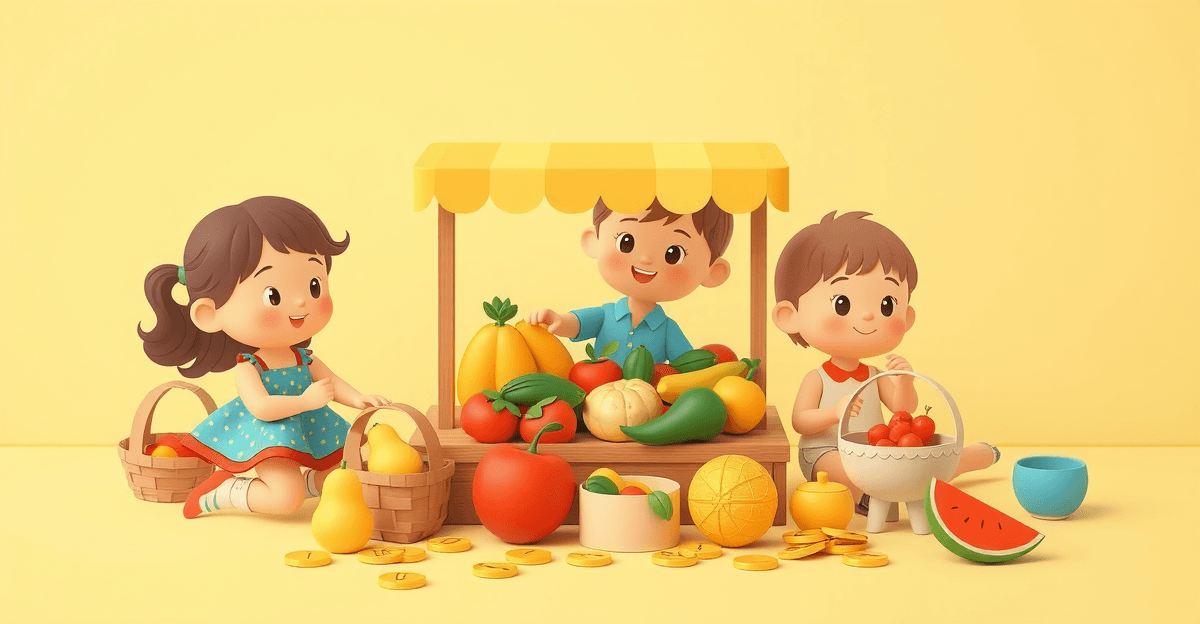
We were at the NTUC checkout when my K1 daughter pointed at the card reader and asked, "Mummy, where does the money go?" That question hit me — she'd been watching us tap our cards for years without understanding that actual money was being exchanged. It got me thinking about when and how to start teaching her about money.
TL;DR: Age-appropriate ways to introduce money concepts to Singapore children aged 4-6. From coin recognition to simple saving habits — a practical guide for K1 and K2 parents.
The good news? Kids aged 4-6 are actually ready to understand the basics of money. Not CPF or compound interest lah — but the foundational ideas that shape their relationship with money for life: that money is exchanged for things, that different amounts buy different things, and that saving means choosing to wait.
This guide offers practical, developmentally appropriate ways to introduce money to your K1 or K2 child — without turning it into a maths lesson.
Why Start at K1-K2?
The case for early financial education is strong. Research from the University of Cambridge found that children's money habits are largely formed by age 7. By the time children reach K1, they are already capable of understanding several key concepts:
- Coins and notes represent value
- Different items cost different amounts
- Money can be saved over time
- There is a difference between wanting something and needing it
In Singapore's context, the MoneySense initiative — a national financial education programme — emphasises that financial habits begin at home, long before formal school instruction. Starting the conversation at K1-K2 aligns with this national priority.
Beyond financial habits, money activities directly support early numeracy. Counting coins, comparing amounts, and working out simple "how much do I have?" calculations are authentic, motivating applications of the maths skills children are building in kindergarten.
Developmentally Appropriate Goals for K1-K2
Before diving into activities, it helps to know what is realistic. At ages 4-6, children can typically:
- Recognise Singapore coins (5c, 10c, 20c, 50c, $1) and notes ($2, $5, $10)
- Understand that different coins have different values
- Count a small collection of identical coins (e.g., five 10-cent coins = 50 cents)
- Understand that things cost money and that money has to be "enough" to buy something
- Begin to grasp the concept of saving — setting money aside now to buy something later
- Distinguish between "want" and "need" with guidance
Children at this age are not ready for complex calculations, interest rates, or budget management. Keep it concrete, visual, and grounded in real experiences.
Activity 1 — Coin Sorting and Recognition
What you need: A handful of Singapore coins in mixed denominations.
How it works:
- Tip the coins onto a table together.
- Ask your child to sort them by size or by the picture on the coin.
- Name each coin as you sort: "This is a ten-cent coin. This is a fifty-cent coin."
- Progress to identifying them independently: "Can you find all the twenty-cent coins?"
Why it works: Sorting is a core cognitive skill at this age, and tying it to real objects makes it memorable. Children learn through physical manipulation — handling actual coins is far more effective than looking at pictures.
Extend it: Once recognition is solid, introduce simple values. "If I give you two ten-cent coins, how many cents do I have altogether?" Keep the numbers small and use identical coins before mixing denominations.
Activity 2 — The Toy Shop at Home
What you need: Small toys or household objects, price stickers (or paper), and a collection of coins.
How it works:
- Set up a simple "shop" on a table with 5-6 items. Price them simply: a toy car for 20 cents, a sticker for 10 cents, a block for 5 cents.
- Give your child a small "budget" — perhaps 50 cents in coins.
- Let them "shop" — choosing what to buy, counting out coins, and receiving "change" if relevant.
- Swap roles: your child becomes the shopkeeper and you are the customer.
Why it works: Play-based learning is the gold standard for early childhood education, supported by both ECDA's Nurturing Early Learners (NEL) framework and decades of research. Role-play makes abstract concepts concrete, and children are deeply motivated when they have agency in a game.
Key conversation prompts:
- "You have 50 cents. The car costs 30 cents. Do you have enough?"
- "If you buy the car, how much will you have left?"
- "You want the car AND the sticker. Do you have enough for both?"
Activity 3 — The Three-Jar System
What you need: Three clear jars or containers, labelled "Spend", "Save", and "Give".
How it works:
- When your child receives money (from a small allowance, angpow, or as a treat), have them divide it among the three jars.
- The "Spend" jar is for things they want now. The "Save" jar is for a specific item they are working towards. The "Give" jar is for contributing to others — a donation box, a small gift for a friend, or a sibling.
- Make the saving goal concrete and visible: cut out a picture of the toy or item they are saving for and tape it to the "Save" jar.
Why it works: The three-jar system — a well-established approach in early financial literacy education — teaches three distinct financial behaviours simultaneously. The visual nature of clear jars means children can see their progress, which is critical for maintaining motivation at this age.
Angpow teachable moment: Chinese New Year is perfect for this. When the angpows come in, help your child count the total, decide what goes into savings, and pick something meaningful for the "Give" jar. My daughter once chose to buy a small toy for her younger sister — melted my heart.
Activity 4 — Supermarket Maths
What you need: Your regular grocery shopping trip.
How it works:
- Before the trip, tell your child they have a small "helper budget" — perhaps $2 — to choose one item for themselves.
- In the supermarket, show them price tags. "This drink is $1.50. Is that more or less than your $2?"
- Let them physically hold the money and hand it to the cashier for their own item.
- Discuss change: "You gave $2 and it cost $1.50. The cashier gives you back 50 cents. Why?"
Why it works: Real transactions are infinitely more powerful than simulations. The moment a child physically hands over money and receives goods in return, the abstract concept of exchange becomes viscerally real. The minor logistics of including a child in a supermarket transaction are worth the developmental payoff.
Extend it: Compare two similar items on price. "The red apple costs 40 cents. The green apple costs 35 cents. Which is cheaper? If we buy the green one, we save 5 cents."
Activity 5 — The "Wait a Week" Challenge
What you need: Just patience and consistency.
How it works:
- When your child asks for a toy or treat, instead of immediately saying yes or no, say: "Let's put that on your Wish List and wait one week. If you still want it after a week, we will talk about it."
- Keep a simple "Wish List" on a piece of paper — your child can draw the item.
- After a week, revisit. Many times, the desire has faded. If it has not, discuss how they could save up for it.
Why it works: Delayed gratification — the ability to wait for a reward — is one of the strongest predictors of future success, as demonstrated by decades of research following the famous Stanford marshmallow experiments. Practising at K1-K2, with low stakes, builds this muscle gradually. The Wish List also teaches children that desires can be honoured and respected without being immediately fulfilled.
Talking About Money — Language That Works
How you talk about money matters as much as the activities you do. Some language frameworks that work well with K1-K2 children:
Instead of "We can't afford that" → try "That's not in our budget today. Let's put it on the Wish List."
The first implies scarcity and can create anxiety. The second teaches planning.
Instead of "Money doesn't grow on trees" → try "Money is something we earn by working and then choose how to use."
The first is a platitude. The second explains the relationship between work and money simply.
Instead of "Stop asking for things" → try "That costs $X. How much do you have in your Save jar?"
The second redirects the conversation toward agency and responsibility.
Connecting Money to Numeracy
Money activities naturally reinforce the numeracy skills your child is building in K1 and K2. Apps like QuizKin develop number sense, counting, and early addition and subtraction — the same skills that underpin money understanding. When your child can recognise that 10 + 10 = 20, they are one step away from understanding that two ten-cent coins make twenty cents.
Look for ways to make the connection explicit: "Remember when we counted to 20 on the app? That's the same as counting two ten-cent coins!"
Common Mistakes to Avoid
Making money a taboo topic. Children who grow up in households where money is never discussed often develop anxious, avoidant relationships with finances. Age-appropriate transparency — "we are saving for a holiday, so we won't buy that toy today" — normalises financial planning.
Rewarding everything with money. While a small allowance for completing age-appropriate responsibilities is reasonable, tying every positive behaviour to financial reward can undermine intrinsic motivation. Keep money conversations separate from discipline and reward systems where possible.
Expecting instant results. Financial habits form slowly and through repetition. A 4-year-old who spends everything immediately is not failing — they are at the beginning of a years-long learning journey. Celebrate small moments of understanding, not perfect behaviour.
A Word on Singapore's CPF and Long-Term Saving
You do not need to explain CPF to a 4-year-old. But you can plant seeds. If your child asks where your money comes from, "Mummy and Daddy work, and the company pays us money" is perfectly sufficient. As they grow, these conversations can expand naturally.
The MoneySense programme offers free resources for parents on age-appropriate financial education across different life stages. Their guidance for young children emphasises exactly what this article focuses on: making money tangible, grounding it in real experience, and keeping the emotional tone around money positive and matter-of-fact.
References
- MoneySense Singapore. Financial Education for Children. https://www.moneysense.gov.sg
- Early Childhood Development Agency (ECDA). Nurturing Early Learners (NEL) Framework. Singapore: ECDA, 2023. https://www.ecda.gov.sg
- University of Cambridge. (2013). Habit Formation and Learning in Young Children. David Whitebread and Sue Bingham. Money Advice Service UK.
- Mischel, W., Shoda, Y., & Rodriguez, M. L. (1989). "Delay of gratification in children." Science, 244(4907), 933-938.
- Furnham, A. (1999). "The saving and spending habits of young people." Journal of Economic Psychology, 20(6), 677-697.
- Health Promotion Board Singapore. Positive Parenting Programme. https://www.hpb.gov.sg
Looking for more? Check out find a tutor for free on TuitionLah.
Exploring parenthood in Singapore? Visit ParentLah for practical tips on raising kids in Singapore.
Practise what you’ve read with QuizKin
Adaptive quizzes covering phonics, sight words, numbers, and more — aligned with the Singapore MOE curriculum. Start your free Premium trial today.
Frequently Asked Questions
Research suggests children as young as 3 can grasp simple money concepts like recognising coins and understanding that things cost money. By ages 4-6 (K1-K2), children are developmentally ready to understand that money is exchanged for goods, that different coins have different values, and that saving means waiting to buy something you want. Starting early builds lifelong financial habits.
A small, regular allowance (even 20-50 cents a week) can be a powerful teaching tool for K1-K2 children. It makes money tangible and gives them real decisions to practise. The amount matters far less than the conversations you have around it — why we save, what things cost, the difference between wants and needs.
Completely normal. Impulse control is still developing strongly at ages 4-6. The goal is not to eliminate immediate spending, but to gently introduce the concept of delayed gratification through real, low-stakes practice. Piggy banks, saving jars, and 'wait a week' experiments are all effective at this age.
Money is one of the most motivating real-world contexts for number learning. Counting coins, comparing amounts, and simple addition and subtraction in a shopping context directly reinforce the numeracy skills children are developing in kindergarten. It makes maths meaningful.
About the author
Mervin Tan
Founder, QuizKin
Mervin Tan is the founder of QuizKin and a software engineer and dad of two young children in Singapore. He builds QuizKin's adaptive quiz engine and writes practical K1-K2 learning guides grounded in MOE's Nurturing Early Learners framework and his own experience preparing his kids for Primary 1. QuizKin is built by Adaptels Pte. Ltd., Singapore.
Ready to make learning fun?
QuizKin turns screen time into learning time with adaptive quizzes built for K1-K2 kids in Singapore. Free to start.
Related Articles
Teaching Numbers & Counting to Preschoolers (Singapore)
Teach your K1-K2 child numbers and counting with 10 fun activities. Covers number recognition, counting skills, and basic addition for Singapore parents.
Teaching Preschoolers to Count Money: Singapore Dollar Activities
Teaching preschoolers to count money the Singapore way — fun, hands-on Singapore dollar activities for K1-K2 kids to build real number sense and confidence.
Sight Words Activities for Singapore Preschoolers: Fun Ways to Build Vocabulary
Discover fun sight words activities for your Singapore preschooler. Practical ideas for K1-K2 kids aged 4-6 to build vocabulary and reading confidence at home.