Building Resilience in Preschoolers: Practical Tips for Singapore Parents (K1-K2)
Help your K1-K2 child build resilience with practical, Singapore-specific tips on growth mindset, emotional skills, and confident learning at home.
Mervin Tan · Founder, QuizKin
Published 13 May 2026
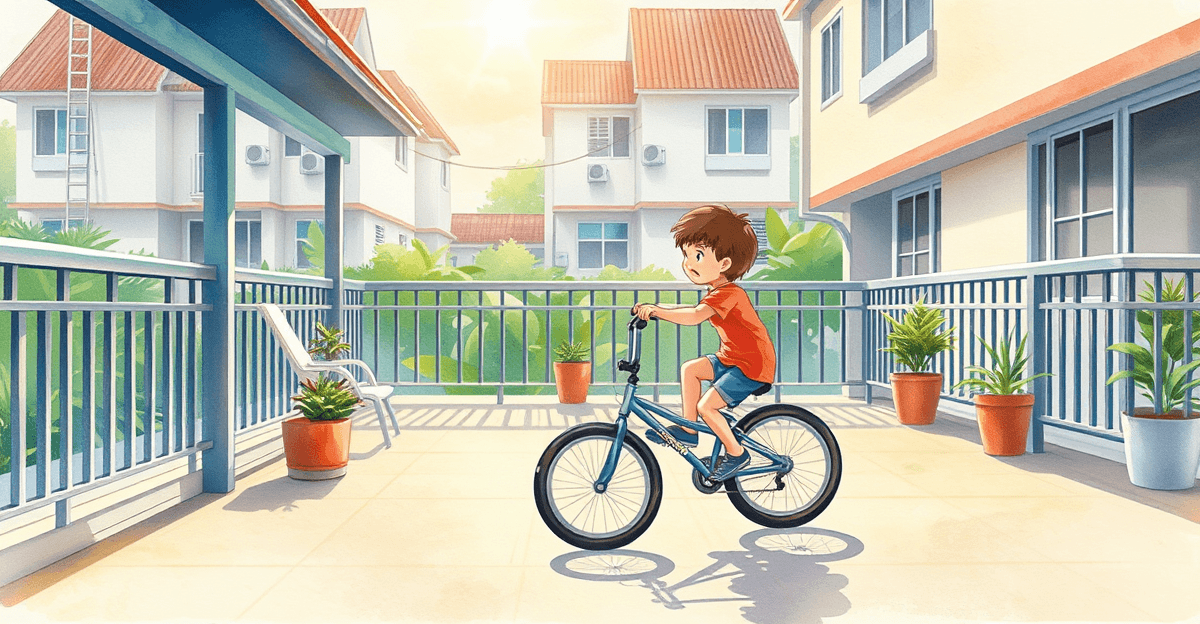
If you have a K1 or K2 child in Singapore, you know this feeling: joy mixed with quiet worry. Your child is learning to read, count, share, argue, and figure out who they are — all at once. And somewhere in the back of your mind, you've started thinking ahead. About Primary 1 transitions. About whether your child will cope when things get hard. My daughter came home from school one day and said "I'm the worst at writing in my class." She's five. That was my wake-up call.
TL;DR: Help your K1-K2 child build resilience with practical, Singapore-specific tips on growth mindset, emotional skills, and confident learning at home.
That last question — will my child cope? — is really a question about resilience. And the good news is that resilience is not a fixed personality trait. It is a skill. One that parents can actively help build, starting right now, at home, in the most ordinary moments of daily life.
What Resilience Actually Means for a 4–6 Year Old
Before diving into strategies, it helps to reset expectations. Resilience in a preschooler does not look like stoic toughness or never crying. It looks more like:
- Trying again after knocking over their block tower
- Using words to say "I'm frustrated" instead of throwing something
- Moving on (eventually) after losing a game
- Asking for help when they're stuck, rather than shutting down
At K1 and K2, children are still developing the brain circuitry that handles emotional regulation. Their prefrontal cortex — the rational, long-view part of the brain — is years away from maturity. What we're doing at this age is laying the groundwork: building emotional vocabulary, practising recovery from small setbacks, and learning that difficult feelings pass.
That context matters, because it shapes what we ask of our children and how we respond when they struggle.
Why Singapore's Education Culture Makes This Even More Important
Singapore parents tend to be highly engaged in their children's learning — and that's genuinely a strength. But the flip side of a high-achievement culture is that children can internalise the idea that mistakes are shameful, or that being "behind" makes them less valuable.
Research from the Child Development Institute and local child psychologists consistently points to the same finding: children who fear failure avoid challenge. They stick to what they already know. They may perform well in structured tasks but struggle when faced with open-ended problems or unexpected setbacks.
Building resilience at K1 and K2 is, in part, about countering this early. It's about raising children who see difficulty as interesting rather than threatening — who say "I can't do this yet" rather than "I can't do this."
Practical Strategies You Can Start This Week
1. Let Them Struggle (Just a Little)
This is the hardest thing for most parents to do, because our instinct is to help immediately. But there's a crucial difference between supportive presence and solving the problem for them.
When your child is stuck on a puzzle or can't get their shoe buckled, try pausing for 60 seconds before jumping in. Let them sit with the discomfort. If they're still stuck, offer a hint — not the answer. "What if you tried the bigger piece first?" This teaches them that struggle is manageable and that they are capable of working through it.
At local playgrounds like those in HDB estates or Bishan-Ang Mo Kio Park, you can see this play out physically. Children who are encouraged to climb a little higher or try the monkey bars independently — even after a fall — tend to re-approach challenges with more confidence than those who are immediately caught and redirected.
2. Build an Emotional Vocabulary
Children who can name their feelings can manage them better. This is not about being "soft" — it's about giving your child tools. A child who says "I feel frustrated" is in a very different mental state from one who is simply overwhelmed with no language for what's happening inside.
At this age, start simple. Feelings cards, picture books, and even just narrating your own emotions ("I'm feeling a bit tired and that made me short-tempered — let me take a breath") all help. Popular preschools like PCF Sparkletots and My First Skool often incorporate Social-Emotional Learning (SEL) into their curriculum, so you can ask your child's teacher what frameworks they use and reinforce them at home.
3. Praise Effort, Process, and Strategy — Not Just Results
This one comes straight from the research of psychologist Carol Dweck, and it works. When you praise your child for being "clever" or "talented", you're linking their self-worth to an outcome they can't always control. When you praise them for trying hard, for a good strategy, or for not giving up, you're teaching them that effort and method are what matter.
In practice, this sounds like:
- "You kept going even when it was hard — that's something to be proud of."
- "I noticed you tried a different way when the first way didn't work. That's really smart thinking."
- "You made a mistake, and then you fixed it. That's exactly how learning works."
4. Normalise Failure — Yours Included
Children learn enormously from watching adults handle setbacks. When you burn dinner, miss a bus, or get something wrong, say so out loud and narrate what you do next. "I got that wrong. Let me think about what to do differently." This de-mystifies failure and makes recovery feel normal.
For Singapore parents who grew up in a culture where showing weakness was frowned upon, this might feel uncomfortable at first. But your child is watching everything — and a parent who models graceful recovery from mistakes is one of the most powerful resilience teachers your child will ever have.
5. Create Low-Stakes Opportunities for Challenge
Introduce activities where it's totally fine to fail, and where failure is even a bit fun. Cooking a new recipe together, building LEGO from memory rather than instructions, playing board games where luck is involved — all of these create a space to practise losing and trying again without any real stakes.
If your child enjoys learning activities on a tablet or computer, tools like QuizKin are designed with this in mind — questions adapt to what the child finds difficult, so they're always working at just the right level of challenge. Getting a question wrong just means another attempt, in a low-pressure environment that keeps things encouraging rather than discouraging. Over time, this kind of repeated "try, miss, try again" experience quietly builds confidence.
6. Develop a Family Recovery Ritual
When big emotions hit — and they will — having a predictable, co-created ritual for calming down makes recovery faster and less dramatic. This could be:
- A "calm corner" in the bedroom with soft toys and a feelings chart
- Deep breaths together (the "birthday cake" breath — inhale like you're smelling a cake, exhale like you're blowing out candles — works well for K1/K2 kids)
- A short walk around the block
- A glass of water and a hug, no questions asked
The ritual itself matters less than its consistency. When children know what comes after the storm, they trust that the storm will pass.
7. Encourage (But Don't Force) Social Risk-Taking
Social situations are a major source of preschool anxiety. New classmates, group activities, birthday parties with unfamiliar kids — all of these require a kind of social courage.
Rather than pushing your child into the deep end, try scaffolding small social challenges. Practise what to say when joining a group ("Can I play too?"). Role-play awkward scenarios at home with puppets or soft toys. After a social situation, debrief warmly: "That looked a bit hard at first. How did it feel after?"
Children who learn early that social discomfort is temporary — and manageable — develop stronger peer relationships and better emotional reserves for the school years ahead.
What Resilience Does NOT Look Like
A quick note on what to avoid, because some well-meaning parenting approaches can accidentally undermine resilience:
Invalidating emotions ("Don't cry, it's nothing") teaches children to suppress, not regulate. The goal is to acknowledge feelings first, then problem-solve.
Over-scheduling children with enrichment activities leaves no time for unstructured play — which is actually where most resilience skills are practised naturally.
Rescuing too quickly from difficulty (academic, social, or physical) sends the implicit message: "I don't think you can handle this." Even when meant kindly, this erodes self-efficacy over time.
Comparing children — especially to siblings or classmates — can turn healthy challenge into identity threat. Every child's resilience journey looks different.
The Long Game: Resilience Before PSLE
It might seem early to be thinking about PSLE culture when your child is in K1. But the groundwork for how your child handles academic pressure in Primary 5 and 6 is being laid right now, in how they respond to the first hard thing they encounter.
Children who grow up in homes where mistakes are learning data, where feelings are named and validated, where effort is celebrated over outcome, and where recovery is practiced again and again — these children arrive at high-stakes moments with a very different internal toolkit than those who don't.
You don't need a special curriculum or a lot of money to build that toolkit. You need consistency, patience, and the willingness to let your child struggle, just enough, while knowing you are right there beside them.
That combination — challenge plus safety — is the environment in which resilience grows.
Quick Summary: What You Can Do Today
- Pause before rescuing — give your child 60 seconds to try on their own
- Name emotions out loud — yours and theirs
- Praise the process, not just the result
- Share your own mistakes and how you recovered
- Create a calm-down ritual and practise it before you need it
- Introduce low-stakes challenge through games, cooking, or adaptive learning tools
- Debrief social situations warmly and without judgment
Resilience is not built in a single lesson or a single year. It's built in a thousand small moments — most of them unremarkable, many of them inconvenient. But the parent who keeps showing up for those moments is giving their child something that no tuition centre or enrichment class can replicate: the deep, bone-level belief that they can handle what comes next.
And that belief, more than any grade or certificate, will carry them far.
Sources
Looking for more? Check out find a tutor for free on TuitionLah.
Exploring parenthood in Singapore? Visit ParentLah for practical tips on raising kids in Singapore.
Practise what you’ve read with QuizKin
Adaptive quizzes covering phonics, sight words, numbers, and more — aligned with the Singapore MOE curriculum. Start your free Premium trial today.
Frequently Asked Questions
Resilience-building can and should start from the toddler years, but ages 4–6 (K1 and K2) are a particularly powerful window. Children at this stage are developing self-awareness and emotional vocabulary, which makes it easier to teach coping strategies in real time. In the Singapore context, this period also comes just before Primary 1 — a major transition — so habits formed now can significantly reduce anxiety later.
First, resist the urge to jump in and solve it for them. Instead, sit beside them, acknowledge the difficulty ('This looks tricky!'), and ask guiding questions ('What do you think we could try first?'). Praise the effort, not the outcome — 'I love how you kept trying' is more powerful than 'You're so smart.' Over time, children learn that struggle is a normal part of learning, not a signal to quit.
High expectations are healthy when paired with strong emotional support. The key is to separate your child's worth from their performance. In Singapore, where academic benchmarks can feel ever-present, it helps to frame learning as a journey with many small wins. Celebrate curiosity, questions, and effort. When children feel safe to fail without losing your approval, they naturally push themselves harder — and bounce back faster when they do struggle.
About the author
Mervin Tan
Founder, QuizKin
Mervin Tan is the founder of QuizKin and a software engineer and dad of two young children in Singapore. He builds QuizKin's adaptive quiz engine and writes practical K1-K2 learning guides grounded in MOE's Nurturing Early Learners framework and his own experience preparing his kids for Primary 1. QuizKin is built by Adaptels Pte. Ltd., Singapore.
Ready to make learning fun?
QuizKin turns screen time into learning time with adaptive quizzes built for K1-K2 kids in Singapore. Free to start.
Related Articles
Building a Growth Mindset in Your K1-K2 Child: Tips for Singapore Parents
Help your K1-K2 child develop a growth mindset at home with practical Singapore-parent strategies — praise effort, embrace mistakes, and build resilience for school.
Separation Anxiety in Kindergarten: A Singapore Parent's Guide to Smoother Drop-Offs
Practical strategies for managing kindergarten separation anxiety in Singapore. Age-specific tips for K1 and K2, when to worry, and how to make drop-offs easier for you and your child.

Best Educational Apps for 4-Year-Olds in Singapore (2026)
Compare the best educational apps for preschoolers in Singapore. Reviews of QuizKin, Khan Academy Kids, Duolingo ABC and more, with MOE alignment focus.