Montessori Activities at Home for Singapore Preschoolers: Practical Life Skills
Discover Montessori practical life activities for K1-K2 kids at home. Simple, budget-friendly ideas aligned with Singapore preschool learning outcomes.
Mervin Tan · Founder, QuizKin
Published 1 June 2026
This article contains affiliate links — if you buy through them, QuizKin may earn a small commission at no extra cost to you. We only link products relevant to the activity.
Your 5-year-old spills water while trying to pour juice, and your first instinct is to take over. But in a Montessori classroom—whether at PAP Community Foundation preschool or My First Skool—this "mistake" is celebrated as a learning moment. Practical life activities are the heart of Montessori education, and they're surprisingly easy to implement at home in Singapore.
TL;DR: Discover Montessori practical life activities for K1-K2 kids at home. Simple, budget-friendly ideas aligned with Singapore preschool learning outcomes.
If you're raising a K1 or K2 child, you've likely noticed their burning desire to do things independently. "I can do it myself!" is the unofficial motto of the 4-6 age group. Montessori practical life activities channel this natural drive into real skills—self-care, household contribution, and confidence that will serve your child far beyond preschool.
This guide shares practical, affordable Montessori activities you can set up in your Singapore home today, aligned with MOE preschool learning outcomes and your child's developmental stage.
What Are Montessori Practical Life Activities?
Montessori practical life activities are real-world tasks designed to build independence, concentration, and fine motor skills. Unlike pretend play, these activities have genuine purpose: your child isn't practicing pouring in a game—they're actually preparing a snack or watering a plant.
Dr. Maria Montessori observed that young children learn best through purposeful, repetitive work with real consequences. A spilled glass of water teaches more than any worksheet ever could.
In the Singapore context, practical life aligns beautifully with MOE's preschool learning outcomes, particularly:
- Self & Social Awareness: Managing personal care and contributing to family routines
- Physical Development: Fine and gross motor skill building
- Cognitive Development: Problem-solving and logical sequencing
The Four Categories of Practical Life Activities
1. Care of Self
These activities build personal independence and self-care habits essential before Primary School entry.
Dressing & Grooming:
- Buttoning/unbuttoning practice boards (use large buttons on fabric strips)
- Zipping practice with old jackets or zipper boards
- Tying shoelace frames (easier than shoes)
- Washing hands independently with step-by-step visual cards
Setting Up for Success:
In Singapore's warm, humid climate, teach your child to manage light clothing changes and personal hygiene. Set a low shelf in the bathroom with a step stool, soap dispenser, and towel at child height. This prepares them for KM (kindergarten) routines at schools like PCF or YMCA preschools.
2. Care of Environment
Children learn that they belong to a community with shared responsibilities—essential for Singapore's values-driven education.
Cleaning Activities:
- Dusting furniture with a small cloth and spray bottle (water only)
- Sweeping with child-sized brooms (sold affordably at Popular or Daiso, or grab a child-sized broom on Shopee)
- Wiping tables after meals with a damp cloth
- Sorting laundry by colour before washing
- Watering indoor plants with a small watering can
Why This Matters for Singapore:
MOE's character development framework emphasises responsibility and care for shared spaces. A child who confidently sweeps learns ownership—the same mindset Singapore schools cultivate for community and nation.
3. Care of Food Preparation
Practical life in the kitchen builds math skills (measuring), science (observation), and real-world contribution.
Safe Food Prep for K1-K2:
- Snack preparation: Spreading soft butter on bread, arranging fruit on a plate
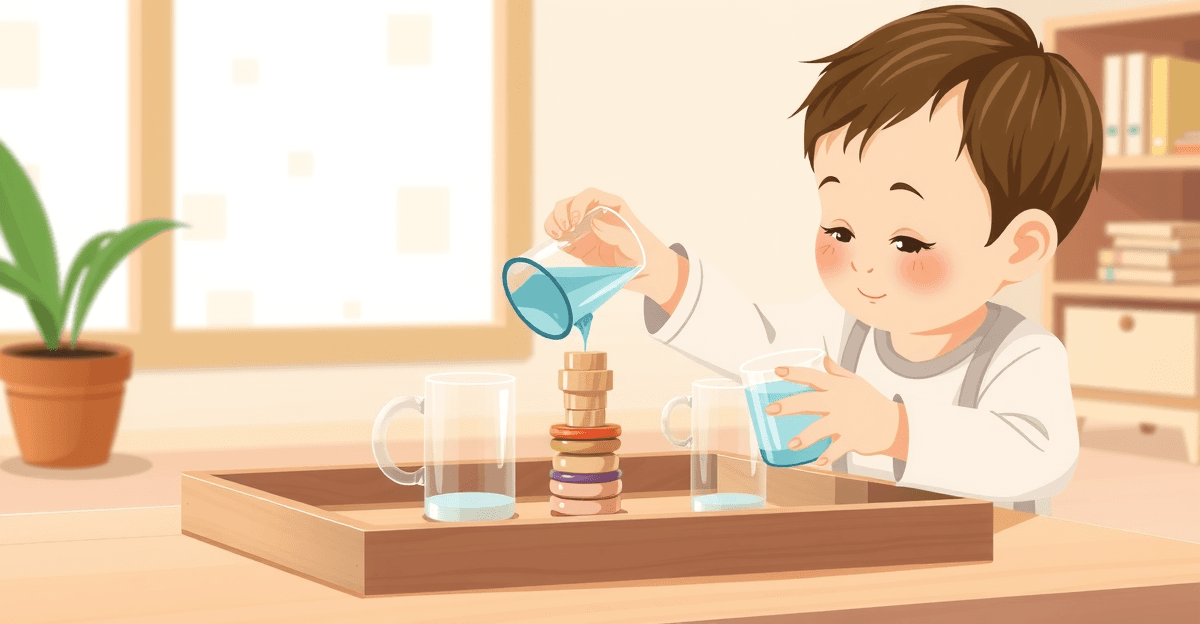
- Pouring: Water, milk, or juice into cups (start with small amounts, low heights)
- Mixing: Combining dry ingredients for simple recipes
- Washing produce: Rinsing vegetables in a bowl
- Peeling: Garlic cloves, hardboiled eggs (with supervision)
Practical Setup:
Use a low shelf or trolley in your kitchen with:
- Child-sized knife (wooden or butter knife)
- Small cutting board
- Lightweight cups and pitchers
- Cloth napkins for cleanup
- Step stool to reach the counter safely
Many Singapore families live in HDB flats with limited space—a small rolling cart works perfectly and can be tucked away when not in use.
4. Grace & Courtesy
These activities teach social skills, empathy, and respectful interaction.
Simple Practice Activities:
- Greeting practice: Role-playing how to greet teachers, visitors, or classmates
- Helping others: Assisting a younger sibling or grandparent with a task
- Table manners: Using utensils correctly, passing food politely
- Asking for help: Practicing phrases like "Could you help me, please?"
Cultural Alignment:
Singapore's multicultural context makes grace and courtesy especially important. Montessori's emphasis on respect and consideration aligns with values taught across MOE preschools and cherished by Singaporean families.
Step-by-Step: Setting Up Practical Life at Home
Start Small
You don't need a perfectly curated Montessori environment. Choose one or two activities your child can do independently. Success builds confidence.
Week 1 Activity Ideas:
- Pouring water between cups (set up on a tray for easy containment)
- Folding cloths or napkins
- Sweeping with a small broom
Create an Accessible Space
Arrange materials at your child's level:
- Low shelves (bookshelf turned sideways works)
- Step stool for reaching counters
- Child-sized tools: available at Daiso, Popular, or online
- Trays or baskets to contain materials
Demonstrate, Don't Teach
Show your child how to do the activity slowly and deliberately, without talking. Let them watch your hands. Then step back—let them try, even if they're slower or messier than you.
This is the Montessori "presentation." Your child learns more from observation and trial than from correction.
Expect Mess (& Embrace It)
Spilled water, scattered flour, or misfolded clothes are not failures. They're data. Your child learns cause and effect: "If I pour too fast, it spills. Next time, I'll slow down."
Keep a cloth or small broom nearby. Let your child clean up their own messes whenever possible—it's part of the learning.
Rotate Activities
Don't present everything at once. Introduce new activities every 1-2 weeks. If your child loses interest in pouring water, try a different activity. Rotation keeps engagement high and prevents overwhelm.
Practical Life Activities by Age
K1 (Age 4-5)
Focus on simple, concrete tasks with visible results:
- Pouring water or juice
- Wiping tables with a damp cloth
- Arranging objects in baskets
- Washing hands independently
- Feeding a pet (if you have one)
- Simple food prep (spreading butter, arranging fruit)
K2 (Age 5-6)
K2 children are ready for more complex sequencing:
- Washing dishes (with supervision, in a shallow basin)
- Folding clothes
- Preparing simple snacks (mixing, measuring)
- Dusting and sweeping
- Buttoning/zipping practice
- Setting the table
- Sorting laundry by colour
Connecting Practical Life to Academic Learning
While practical life is its own reward, it naturally supports academic skills. A child who pours water learns about volume and spatial reasoning. One who folds clothes practices geometry.
Consider complementing hands-on practical life with adaptive quiz practice that makes learning fun and measurable for K1-K2 kids—tools like QuizKin help parents track cognitive development alongside life skills, giving a fuller picture of your child's growth as they prepare for Primary School entry.
Common Challenges & Solutions
"My Child Moves Too Slowly"
This is a feature, not a bug. Concentration develops through repetition and time. A child who spends 10 minutes carefully pouring water is building focus that will serve them in Primary School. Resist the urge to speed them up.
"I'm Worried About Safety"
Start with very low-risk activities: pouring water, wiping cloths, sorting objects. Supervise closely, and use child-safe materials. As your child demonstrates competence and carefulness, gradually introduce activities with mild consequences (like washing dishes).
"My Child Won't Stay Focused"
Some children need shorter, simpler tasks. A 4-year-old might pour water for just 3 minutes before moving on—that's perfectly normal. Offer choices: "Would you like to sweep or wipe the table?" Choice increases engagement.
"Our Flat is Small"
Singapore HDB flats don't require grand setups. A small rolling cart, a corner shelf, or even a low basket under the dining table can hold practical life materials. Quality matters more than quantity.
Practical Life & MOE Learning Outcomes
Singapore's MOE preschool framework identifies five learning outcomes. Practical life activities directly support three:
- Self & Social Awareness: Care of self activities build autonomy and self-care habits
- Physical Development: Fine and gross motor skills improve through pouring, folding, sweeping, and dressing
- Cognitive Development: Sequencing, problem-solving, and logical thinking emerge naturally
As your child approaches Primary 1, these foundational skills—independence, concentration, responsibility—matter as much as academic readiness.
Beyond the Home: Montessori in Singapore Preschools
If you're interested in a fully Montessori approach, Singapore has dedicated schools:
- Montessori schools across the island (Bukit Timah, East Coast, Clementi branches)
- Montessori-inspired classrooms at PCF, YMCA, and other preschool chains
But you don't need to enrol in a Montessori school to benefit. The principles work beautifully at home, alongside any preschool your child attends.
Your Action Plan This Week
- Choose one practical life activity appropriate for your child's age
- Gather materials (you likely already have them at home)
- Set up a low shelf or tray in an accessible location
- Demonstrate the activity once, then step back
- Observe your child's work without interruption
- Allow time for independent practice and cleanup
That's it. You've begun.
Final Thoughts
Montessori practical life isn't about creating a perfect, Instagram-worthy learning environment. It's about trusting your child's natural desire to contribute, to master skills, and to belong to their family community.
In a world obsessed with academic acceleration, Montessori reminds us that a child who can pour water, fold clothes, and greet guests with courtesy is already learning deeply—about themselves, their home, and their place in the world.
Your Singapore home is the perfect classroom. Start today.
Have questions about implementing Montessori at home? Share your experiences in the comments below—we'd love to hear how practical life activities are unfolding in your family.
Sources
- ECDA — Early Childhood Development Agency
- MOE — Preschool Education
- MOE — Nurturing Early Learners Framework
Looking for more? Check out find a tutor for free on TuitionLah.
Exploring parenthood in Singapore? Visit ParentLah for practical tips on raising kids in Singapore.
Practise what you’ve read with QuizKin
Adaptive quizzes covering phonics, sight words, numbers, and more — aligned with the Singapore MOE curriculum. Start your free Premium trial today.
Frequently Asked Questions
The Ministry of Education's (MOE) preschool framework emphasises self-directed learning and life skills development, which aligns perfectly with Montessori principles. Activities like self-care and household tasks support the Learning Outcomes in Social & Emotional Development and Physical Development. Many Singapore preschools like PCF and My First Skool integrate Montessori-inspired practical life work into their daily routines.
Children aged 4-6 years old are ideal for introducing practical life activities. K1 children (age 4-5) can begin with simpler tasks like pouring and scooping, while K2 children (age 5-6) are ready for more complex activities like washing dishes and folding clothes. Always prioritise safety and supervise activities closely.
No—authentic Montessori practical life doesn't require expensive materials. Use everyday household items: real dishes, child-sized utensils, water, beans, and cloths. The key is choosing activities that are purposeful and developmentally appropriate. This approach is budget-friendly for Singapore families and equally effective.
Observe your child's independence, concentration, and ability to complete tasks without help. Keep a simple checklist of new skills they've mastered (e.g., pouring water, buttoning clothes). Pairing hands-on practice with adaptive quiz practice that makes learning fun and measurable helps reinforce foundational concepts like following instructions and self-care awareness.
About the author
Mervin Tan
Founder, QuizKin
Mervin Tan is the founder of QuizKin and a software engineer and dad of two young children in Singapore. He builds QuizKin's adaptive quiz engine and writes practical K1-K2 learning guides grounded in MOE's Nurturing Early Learners framework and his own experience preparing his kids for Primary 1. QuizKin is built by Adaptels Pte. Ltd., Singapore.
Ready to make learning fun?
QuizKin turns screen time into learning time with adaptive quizzes built for K1-K2 kids in Singapore. Free to start.
Related Articles
Building Emotional Intelligence in K1-K2 Kids: Activities for Singapore Families
Help your K1-K2 child develop emotional intelligence with practical, fun activities. Expert tips for Singapore parents aligned with MOE values and preschool development.
Simple Cooking Activities for Singapore Preschoolers: Learning Through Food
Discover fun cooking activities for K1-K2 kids in Singapore that build maths, science, and language skills. Perfect for busy parents!
Nature Play and Learning for Singapore Kids: Outdoor Exploration Ideas
Discover outdoor nature play activities for Singapore K1-K2 kids (4-6 years). Boost early learning through exploration, observation & hands-on discovery.