Fun Preschool Maths Activities at Home for Singapore Kids (K1-K2)
Discover 10 fun preschool maths activities for Singapore K1-K2 kids (ages 4-6). MOE-aligned ideas you can do at home to build strong numeracy foundations.
Mervin Tan · Founder, QuizKin
Published 13 May 2026
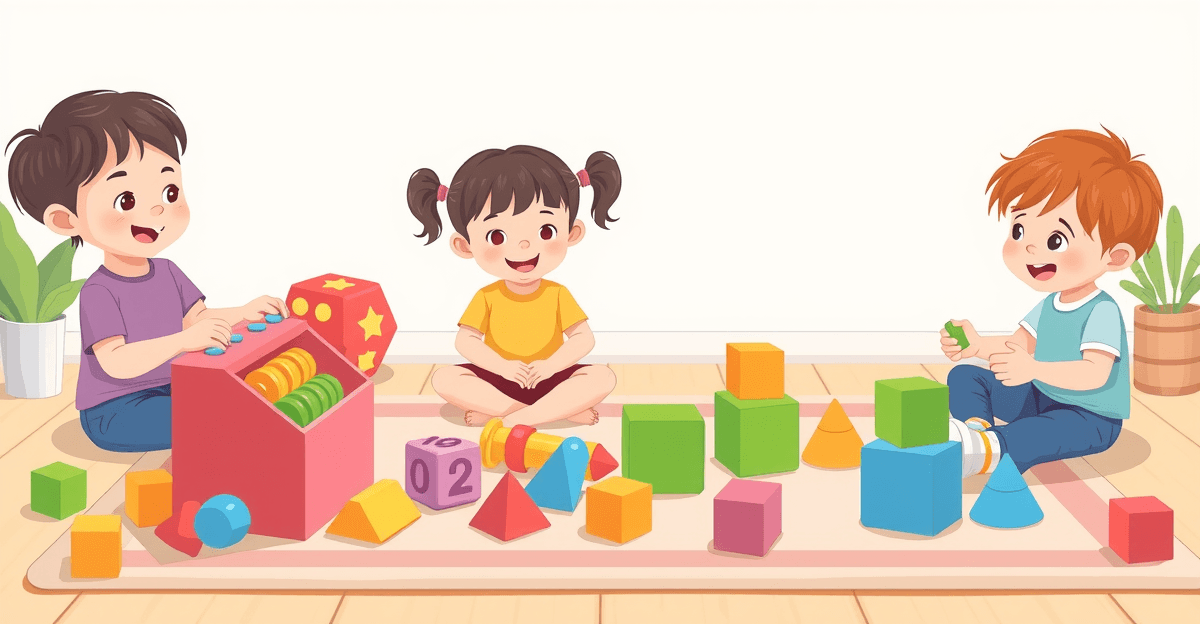
Have you ever watched your child count the floors as the lift goes up, or quietly sort their fish crackers by colour before eating them? If so, you already know something important: young children are naturally wired for mathematical thinking. The trick is to meet them where they are — and Singapore parents have a unique window in K1 and K2 to build numeracy foundations that will serve their children for years to come.
TL;DR: Discover 10 fun preschool maths activities for Singapore K1-K2 kids (ages 4-6). MOE-aligned ideas you can do at home to build strong numeracy foundations.
Whether your child attends PCF Sparkletots, My First Skool, or another local kindergarten, the activities below can reinforce what they're learning in class and make numbers feel like second nature long before Primary One begins.
Why Early Maths Matters More Than You Think
MOE's Kindergarten Curriculum Framework (KCF) treats numeracy as a core developmental domain, not a nice-to-have. By K1, children are expected to be building an understanding of numbers up to 10, basic shapes, and simple patterns. By K2, that extends to numbers up to 20, early addition and subtraction, and informal measurement concepts.
But the KCF isn't designed to turn four-year-olds into calculators. It's about building mathematical thinking — the ability to notice, compare, reason, and problem-solve. The good news? You don't need worksheets or a whiteboard to do this. Everyday life in Singapore is full of maths opportunities.
The habits formed now also matter long-term. Research consistently shows that numeracy skills at age five are among the strongest predictors of maths performance in upper primary — well before PSLE is even a thought.
What Maths Concepts Are Covered in K1 and K2?
Before diving into activities, it helps to know what your child is working on at school.
K1 (age 4-5):
- Numbers 1 to 10 — counting, recognising numerals, ordering
- Basic 2D shapes — circle, square, triangle, rectangle
- Simple AB patterns
- Comparing quantities and sizes — more/less, bigger/smaller
K2 (age 5-6):
- Numbers up to 20 (and sometimes higher)
- Simple addition and subtraction within 10
- 3D shapes — sphere, cube, cone, cylinder
- Informal measurement — length, weight, capacity
- Ordinal numbers — first, second, third
- More complex patterns — AAB, ABB
Keeping these in mind helps you pitch activities at the right level — not too easy, not frustrating.
10 Fun Maths Activities You Can Do at Home
1. Count Everything (Seriously, Everything)
Counting out loud is the single most powerful early numeracy habit. Count the steps from the lift to your front door. Count how many wanton dumplings are in the bowl. Count the number of people waiting at the bus stop.
For K1 children, keep it within 10 and make it rhythmic and fun. For K2 children, challenge them to count in twos, or start from a number other than one ("Can you count on from 8 to 17?"). This builds genuine number sense in a way that flashcards alone never can.
2. Sorting and Classifying at the Wet Market
The next time you head to the wet market or NTUC, bring your child along. Ask them to sort vegetables by colour, or group the fruits by size. This might sound trivially simple, but sorting is a foundational maths skill — it teaches children to identify attributes, compare, and categorise, all of which underpin data handling concepts they'll encounter in primary school.
At home, you can do the same with toys, household objects, or socks from the laundry pile.
3. Shape Hunts Around the House
Challenge your child to a shape hunt. How many rectangles can they spot in the living room? Are there any circles in the kitchen? What shape is the window?
For K2 children, extend this to 3D shapes — the Milo tin is a cylinder, the tissue box is a cuboid, the birthday party hat is a cone. Shape recognition builds spatial reasoning, which quietly underpins many primary school topics later: fractions, area, geometry, and even algebraic thinking.
4. Pattern Play with Snacks
Patterns are foundational in early maths. Lay out a sequence with grapes and blueberries — grape, blueberry, grape, blueberry — and ask your child to continue it. Or use blocks, stickers, or small toys.
Start with AB patterns for K1 children (red, blue, red, blue) and progress to ABB or AAB patterns for K2 (red, blue, blue, red, blue, blue). Once children can extend patterns, ask them to create their own — this is where deeper mathematical thinking kicks in, because they have to hold the rule in mind while producing it.
5. Simple Addition at the Kopitiam
The hawker centre is an underrated maths classroom. At the kopitiam, let your child help count the dishes on the tray. "We have 2 plates of rice and 1 bowl of soup. How many things altogether?" This is concrete, contextual addition — far more meaningful than abstract number sentences written on a page.
Gradually move from physical objects to mental counting: "If we order one more teh, how many drinks do we have?" By K2, many children can handle simple sums to 10 in their heads with a bit of regular practice.
6. Measurement Fun in the Kitchen
Cooking is a goldmine for measurement vocabulary. Let your child pour water into a cup and compare "full" versus "half full". Ask whether the cucumber or the carrot is longer. Let them hold a bag of rice in each hand and tell you which feels heavier.
These informal measurement activities align directly with the K2 curriculum. You're not teaching them to use rulers yet — you're building the conceptual understanding that measurement is about comparison and units, which is exactly the foundation the primary school curriculum builds on.
7. Singapore Coin Recognition
Singapore coins — 5 cents, 10 cents, 20 cents, 50 cents — are wonderful hands-on learning tools. Pull out a handful and ask your child to sort them by size. Can they tell you which coin is worth more? Do they know the 50-cent coin is worth five 10-cent coins?
By K2, most children can identify all Singapore coins by denomination. Making coins familiar now takes the mystery out of money maths, which appears formally in Primary 1 and 2 and trips up many children who've had no prior exposure.
8. Number Games During the Commute
MRT rides and bus trips are perfect for number games. Play "I Spy a Number" — find the number 7 on station signage, advertisements, or seat numbers. Or take turns counting backwards from 10 (or 20 for K2).
You can also try simple number riddles: "I'm thinking of a number that is two more than 6. What is it?" These oral number games build mental maths agility and keep children engaged without a screen — and they require nothing at all to set up.
9. Maths Storybooks in English and Mandarin
Singapore's National Library Board has an excellent selection of maths picture books available for free borrowing. Look for titles that embed number concepts in narrative — books like Rooster's Off to See the World (counting and sets) or The Very Hungry Caterpillar (sequencing and ordinal days) make abstract ideas concrete and memorable.
For Mandarin-medium households, NLB also stocks Mandarin maths picture books. Weaving maths into bedtime reading sends a clear message: numbers are part of everyday life, not just something that happens at school.
10. Structured Practice That Goes at Their Pace
Once your child has a feel for a concept through hands-on play, a little structured practice helps cement it. QuizKin offers adaptive quiz practice designed for K1 and K2 children — it adjusts in real time to your child's current level so they're always working on something appropriately challenging. A five-minute session a few times a week can meaningfully reinforce whatever they're covering in preschool, and the immediate feedback helps parents see exactly where their child is confident and where they need a bit more time.
Making Maths Part of Daily Life (Without Turning Into a Tutor)
The most effective thing Singapore parents can do is resist the urge to formalise everything. You don't need to sit your child down with a workbook every day. Maths is already happening at the dinner table, on the playground, in the lift, and at the supermarket.
A few principles that work well:
Follow their curiosity. If your child is obsessed with dinosaurs, count dinosaurs. If they love stickers, make patterns with stickers. Genuine interest is the most powerful learning accelerator available to you.
Use maths talk naturally. Language like "more than", "less than", "the same as", "how many more do I need?" embeds mathematical vocabulary into ordinary conversation without feeling like a lesson.
Make mistakes okay. When your child gets a sum wrong, resist correcting immediately. Ask: "How did you get that? Can you show me?" The thinking process matters far more than the answer at this stage.
Consistency over intensity. Ten minutes of maths talk daily beats a two-hour Saturday session. Short, regular exposure builds fluency far more effectively than occasional cramming.
What About Assessment Books?
Singapore parents often wonder whether to buy maths assessment books for K1 and K2. The honest answer: they're not necessary at this stage, and they can backfire if introduced too early. A child who finds them engaging might enjoy one page a few times a week — that's fine. But if they resist, don't push. The hands-on activities above will do more for their development than any assessment paper.
What matters far more is that your child enters Primary 1 with genuine number sense, spatial awareness, and confidence around numbers. Those foundations are built through play, conversation, and daily experience — not by racing through past-year papers at age five.
Building Confidence Before Primary One
The most valuable thing you can give your child before Primary One isn't a head start on P1 content — it's the belief that they can do maths. Children who arrive at Primary 1 with a positive maths identity, the sense that "I am someone who gets numbers", are far more resilient when harder material arrives.
Celebrate effort over correctness. Say "I noticed you kept trying even when it was tricky" more than "well done, you got it right". These small shifts in how you respond to maths moments at home can have an outsized impact on how your child relates to the subject for years to come.
Final Thoughts
You don't need to be a maths teacher to raise a mathematically confident child. Singapore's K1 and K2 years are the perfect window to build numeracy through curiosity, play, and conversation — and every activity in this post fits into routines you're already doing, with no special materials required.
Start small. Pick two or three activities that feel natural for your family and build from there. And remember: every time your child counts the fish balls in their bowl, spots a pattern on the hawker centre floor, or figures out which coin to hand over at the drink stall, they are doing real mathematics — with you right there to notice it.
Sources
- MOE — Preschool Education
- ECDA — Early Childhood Development Agency
- MOE — Nurturing Early Learners Framework
Looking for more? Check out find a tutor for free on TuitionLah.
Exploring parenthood in Singapore? Visit ParentLah for practical tips on raising kids in Singapore.
Practise what you’ve read with QuizKin
Adaptive quizzes covering phonics, sight words, numbers, and more — aligned with the Singapore MOE curriculum. Start your free Premium trial today.
Frequently Asked Questions
In K1 (age 4-5), children typically learn numbers up to 10, basic 2D shapes, simple AB patterns, and size comparisons like bigger/smaller. By K2 (age 5-6), they progress to numbers up to 20, simple addition and subtraction within 10, 3D shapes, informal measurement, and ordinal numbers. These align with MOE's Kindergarten Curriculum Framework, which preschools like PCF Sparkletots and My First Skool follow. If you're unsure where your child stands, check with their teacher or try an adaptive tool like QuizKin to see which concepts they've mastered.
For K1-K2 children, short and frequent beats long and infrequent. Aim for 10-15 minutes of intentional maths activity each day — a quick counting game at dinner, a shape hunt before bath time, or a few quiz questions on an app. Children at this age have limited sustained attention, so keeping sessions short and playful prevents maths from feeling like a chore. Consistency over several weeks matters far more than intensity on any single day.
Building strong early numeracy foundations absolutely helps, but the advantage isn't about knowing P1 content ahead of time — it's about number confidence and mathematical thinking. Children who arrive at Primary 1 able to reason about numbers, recognise patterns, and approach problems with curiosity adapt to formal school maths far more easily. Focus on building these habits through play and daily conversation in K1-K2, rather than rushing ahead to primary school content, which can create pressure that undermines a child's natural love of learning.
About the author
Mervin Tan
Founder, QuizKin
Mervin Tan is the founder of QuizKin and a software engineer and dad of two young children in Singapore. He builds QuizKin's adaptive quiz engine and writes practical K1-K2 learning guides grounded in MOE's Nurturing Early Learners framework and his own experience preparing his kids for Primary 1. QuizKin is built by Adaptels Pte. Ltd., Singapore.
Ready to make learning fun?
QuizKin turns screen time into learning time with adaptive quizzes built for K1-K2 kids in Singapore. Free to start.
Related Articles
Fun Maths Activities for K1-K2 Kids in Singapore: Beyond Worksheets
Discover engaging maths activities for K1-K2 kids in Singapore. Move beyond worksheets with hands-on games that build numeracy skills aligned to MOE curriculum.
How Siblings Can Learn Together at Home: Activities for K1-K2 Kids in Singapore
Discover fun sibling learning activities for K1-K2 kids in Singapore. Build skills together with games, crafts, and activities aligned with MOE curriculum.
Teaching Shapes and Patterns to K1-K2 Kids: Hands-On Activities for Singapore Parents
Master shapes and patterns teaching for K1-K2 kids with hands-on activities aligned to Singapore MOE curriculum. Expert tips for preschool parents.