Developing Social Skills in Preschoolers: Tips for Singapore Parents
Practical guide to helping your K1-K2 child build social skills — sharing, turn-taking, conflict resolution, and making friends. Singapore-focused advice.
QuizKin Team
Published 6 June 2026
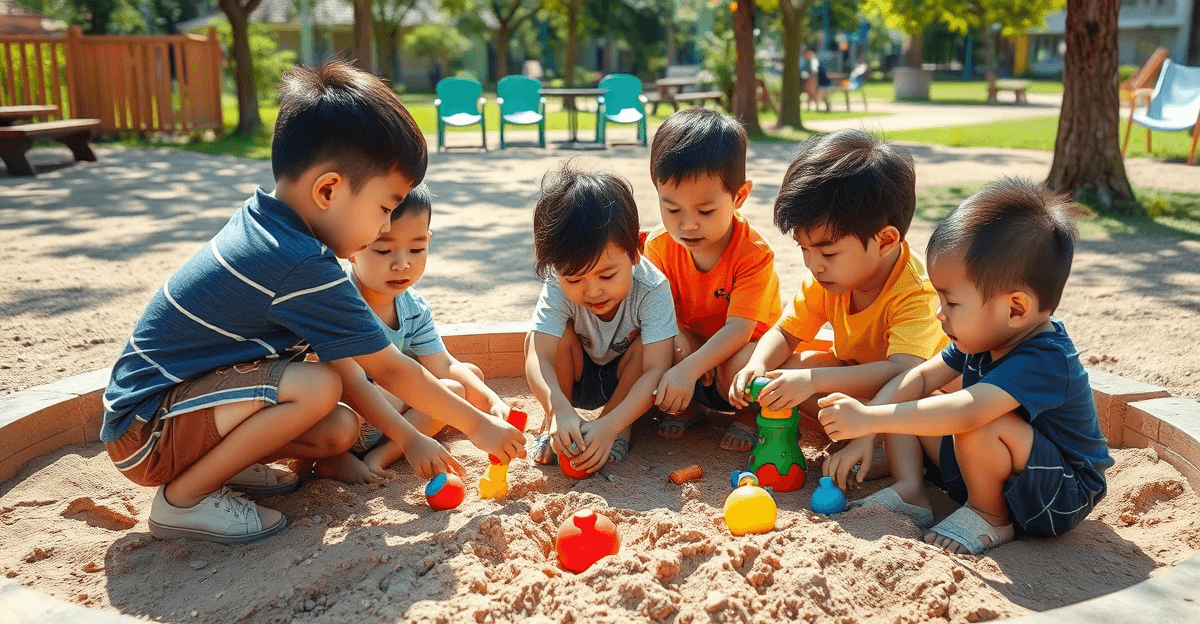
Your child comes home from preschool and announces, "Nobody wants to play with me." Or maybe you have watched from the sidelines at a birthday party while your K1 child stands alone, clutching their goodie bag, watching other children chase each other around the playground. It stings. And you immediately start wondering: is something wrong? Should I intervene? Is my child going to struggle socially in Primary 1?
Take a breath. Social skills are not innate talents that children either have or do not have. They are learned behaviours — and the preschool years (ages 4 to 6) are precisely when these skills develop most rapidly. The fact that your child is still figuring it out is normal. The fact that you are reading this article means you are already doing the right thing.
TL;DR: Social skills — sharing, turn-taking, empathy, conflict resolution, and cooperative play — develop rapidly between ages 4 and 6. Singapore parents can support this development through regular playdates, role-playing social scenarios at home, reading books about emotions, and modelling positive social behaviour. Avoid over-scheduling enrichment at the expense of free play, which is where children practise social skills most naturally. Most children who seem "behind" socially simply need more low-pressure opportunities to interact with peers.
Why Social Skills Matter (Even More Than Academics)
In Singapore's achievement-oriented culture, it is tempting to prioritise academic readiness — making sure your K1 child can read, count, and write before Primary 1. But research consistently shows that social-emotional competence is a stronger predictor of long-term success than early academic skills.
A landmark study published in the American Journal of Public Health tracked children from kindergarten for 20 years and found that those with strong social skills in kindergarten were significantly more likely to graduate from university, hold full-time jobs, and avoid substance abuse — regardless of their academic ability at age 5.
Closer to home, Singapore's MOE Nurturing Early Learners (NEL) framework explicitly identifies social and emotional development as one of six key learning areas for preschoolers. When MOE kindergarten teachers assess children, they are looking at how well a child cooperates, communicates, and manages emotions — not just whether they can recite the alphabet.
What Social Skills Look Like at Each Stage
Age 4 (Nursery 2 / K1):
- Beginning to play cooperatively (not just alongside) other children
- Starting to understand taking turns, though still needs reminders
- Can express basic emotions ("I am sad," "I am angry")
- May have a "best friend" but friendships are fluid
- Struggles with sharing favourite toys
Age 5 (K1 / K2):
- Engages in cooperative play with rules (simple board games, pretend play with roles)
- Can take turns more reliably
- Beginning to show empathy ("Are you okay?")
- Starts to understand that others have different feelings
- Can follow group instructions at preschool
Age 6 (K2 / Primary 1):
- Can negotiate and compromise during play
- Shows concern for friends' feelings
- Understands basic social rules (greeting adults, saying please and thank you)
- Can work in small groups on shared tasks
- Begins to form more stable friendships
7 Practical Ways to Build Social Skills at Home
1. Prioritise Free Play Over Structured Activities
This might be the hardest advice for Singapore parents to follow. In a culture where every afternoon is booked with enrichment classes — Chinese tuition, art class, swimming, phonics — free, unstructured play often gets squeezed out.
But free play is where social skills are forged. When children play together without adult direction, they must negotiate roles ("I will be the doctor, you be the patient"), resolve conflicts ("I had it first!"), read social cues, and adapt their behaviour to keep the play going. No enrichment class can replicate this.
Practical step: Block out at least 2-3 afternoons per week with no enrichment classes. Use this time for playground visits, playdates, or simply letting your child play with neighbours or cousins. If you are looking for enrichment vs home learning balance, remember that play is learning too.
2. Arrange Regular Playdates (Start Small)
If your child is shy or socially cautious, do not throw them into a large group and hope for the best. Start with one-on-one playdates in a familiar environment — your home is ideal.
How to structure a playdate for a socially cautious child:
- Invite one friend, not three
- Keep it short (60-90 minutes maximum for the first few)
- Have a few activity options ready (craft, building blocks, water play) but let the children choose
- Stay nearby but do not direct the play — intervene only if someone is upset or unsafe
- Serve a snack together (eating together is a natural social bonding activity)
Ask your child's preschool teacher which classmates your child interacts with most. Sometimes the child they talk about at home is not actually their closest peer at school — teachers see dynamics that parents do not.
3. Role-Play Social Scenarios
Children learn social scripts the same way they learn phonics or maths — through practice and repetition. Role-playing common social situations at home gives your child a toolkit they can draw on at preschool.
Scenarios to practise:
- Asking to join a game: "Can I play with you?"
- Responding when someone says no: "Okay, maybe later" (this one is hard for adults too)
- Sharing a toy: "You can have a turn after me"
- Saying sorry and meaning it: "I am sorry I knocked your tower down. Can I help rebuild it?"
- Introducing themselves: "Hi, my name is ___. What is your name?"
Use stuffed animals or puppets if your child is self-conscious about role-playing directly. Make it playful, not preachy. And practise the hard ones repeatedly — "what do you do when someone takes your toy?" is a scenario that will come up dozens of times in K1.
4. Read Books About Emotions and Friendships
Stories are one of the most effective tools for building empathy and social understanding. When your child reads about a character who feels left out, scared, or angry, they process those emotions safely and learn vocabulary to describe their own feelings.
Singapore-friendly book recommendations:
- The Colour Monster by Anna Llenas — helps children identify and name emotions
- Have You Filled a Bucket Today? by Carol McCloud — teaches kindness as a daily practice
- Enemy Pie by Derek Munson — about turning an "enemy" into a friend
- My Mouth Is a Volcano! by Julia Cook — about learning not to interrupt
- Hands Are Not for Hitting by Martine Agassi — about physical boundaries
After reading, ask open-ended questions: "How do you think the monster felt when nobody played with him?" or "Has that ever happened to you at school?" These conversations build emotional literacy — the foundation of all social skills.
If your child enjoys learning through interactive formats, tools like QuizKin can complement book learning by helping them practise comprehension and reasoning in a way that feels like play rather than study.
5. Model the Social Behaviour You Want to See
Children learn more from watching you than from anything you tell them. If you want your child to greet people politely, make sure you greet the security guard, the hawker centre uncle, and your neighbours warmly. If you want your child to share, let them see you sharing food with a friend or lending something to a neighbour.
Specific modelling opportunities:
- When you disagree with your partner, resolve it calmly in front of your child (not every argument, but enough that they see healthy conflict resolution)
- When you make a mistake, apologise genuinely: "I am sorry I raised my voice. That was not the right way to handle my frustration."
- When you meet someone new, narrate what you are doing: "I am going to introduce myself to our new neighbour. Watch how I do it."
Singapore culture sometimes emphasises obedience over social assertiveness, but both matter. A child who can politely decline, assert their boundaries, and speak up for themselves is better equipped for the social dynamics of Primary 1 than one who is merely compliant.
6. Teach Emotional Vocabulary
Many preschoolers have exactly two emotional gears: happy and crying. They lack the vocabulary to express what they are actually feeling, which leads to meltdowns, hitting, or withdrawal.
Expand their emotional vocabulary deliberately:
- Beyond "happy": excited, proud, grateful, relieved, calm, silly
- Beyond "sad": disappointed, lonely, frustrated, embarrassed, worried, jealous
- Beyond "angry": annoyed, furious, irritated, unfair
Use these words yourself: "I feel frustrated because the traffic is really bad today" or "I think you might be feeling disappointed because we cannot go to the playground." When your child hears you label emotions precisely, they learn to do the same.
The social-emotional learning approaches used in Singapore preschools following the NEL framework include emotion coaching — and parents who reinforce the same language at home see faster progress.
7. Manage Your Own Expectations
Not every child will be the life of the party, and that is perfectly fine. Some children are naturally introverted — they recharge through quiet time alone and prefer one close friend over a big group. This is a temperament difference, not a social deficit.
Signs of healthy introversion (not a problem):
- Prefers one or two close friends over large groups
- Takes time to warm up in new settings but engages eventually
- Enjoys parallel play (playing near, but not directly with, other children)
- Is content playing alone at home
Signs that may warrant professional attention:
- Complete avoidance of all peer interaction after 6+ months at preschool
- Persistent aggression toward other children (hitting, biting) beyond age 4
- Extreme anxiety about social situations (crying, clinging, refusing to go to school)
- No interest in other children whatsoever by age 5
- Difficulty understanding basic social cues (does not respond to their name, does not make eye contact)
If you notice these patterns, speak to your child's preschool teacher first — they see your child in social settings daily and can offer perspective. If concerns persist, a developmental paediatrician or child psychologist can assess whether intervention is needed. Early intervention in Singapore is well-supported through EIPIC and other programmes.
Social Skills at Singapore Preschools: What Happens in the Classroom
Understanding what your child's preschool does to build social skills helps you reinforce the same approach at home.
The NEL Framework Approach
MOE-registered preschools in Singapore follow the Nurturing Early Learners framework, which includes "Social and Emotional Development" as a core learning area. Teachers are trained to:
- Create small group activities that require cooperation (building projects, dramatic play corners, group art)
- Use circle time to discuss feelings and social situations
- Mediate conflicts using guided language rather than simply punishing
- Recognise and praise prosocial behaviour ("I noticed you helped Mei Ling pick up her crayons. That was very kind.")
Common Preschool Social Programmes
Many Singapore preschools (PCF Sparkletots, My First Skool, PAP Community Foundation centres) incorporate specific social skills programmes:
- Show and Tell: Builds confidence in speaking to a group
- Buddy systems: Pairing older K2 children with younger K1 children
- Community helpers projects: Learning about different roles and developing empathy
- Conflict resolution corners: A quiet space where children learn to talk through disagreements with a teacher's guidance
Ask your child's teacher what specific social-emotional curriculum they use and what language they employ for conflict resolution. Using the same phrases at home ("use your words," "gentle hands," "how did that make you feel?") creates consistency that helps your child internalise the behaviours faster.
The Role of Play in Building Social Skills
Play is not just a break from learning. For preschoolers, play is where the most important learning happens — particularly social learning.
Types of Play and What They Build
Pretend play / dramatic play: When children play "restaurant" or "doctor," they practise perspective-taking (seeing the world through someone else's role), language skills, and negotiation ("You be the customer this time, I was the customer last time").
Board games and card games: Games with rules teach turn-taking, winning and losing gracefully, following instructions, and strategic thinking. Simple games like Snap, Uno, and Snakes and Ladders are excellent for K1-K2. If your child is competitive, these are safe environments to practise losing without it mattering.
Outdoor playground play: Unstructured playground time requires real-time social negotiation — who goes down the slide first, how to share the swing, what to do when someone cuts the queue. These micro-conflicts are learning opportunities, not problems.
Art and craft activities: Collaborative art projects — making a mural together, building a Lego city, creating a puppet show — teach teamwork and compromise. For more ideas, explore creative storytelling activities that naturally involve social interaction.
Preparing Social Skills for Primary 1
The jump from kindergarten to Primary 1 is one of the biggest social transitions in a Singapore child's life. Class sizes grow, structure increases, and children must navigate a much more complex social landscape — with less teacher hand-holding.
What Primary 1 Demands Socially
- Working in groups during project-based learning
- Following class rules and routines independently
- Managing conflicts without a teacher intervening every time
- Making new friends in a larger, less familiar environment
- Handling peer pressure and playground politics
If you are working on P1 readiness, remember that social preparedness is just as important as academic preparedness. A child who can read but cannot cooperate in a group will struggle more than a child who is still learning to read but makes friends easily.
For families who want to complement social development with academic confidence, adaptive learning tools like QuizKin help K1-K2 children build skills at their own pace — freeing up energy and confidence that carries over into social settings. When children feel capable academically, they are more willing to engage socially.
When to Seek Professional Help
Most social skill challenges in preschoolers resolve with time, patience, and practice. But some children benefit from professional support:
- Speech and language delays can make social interaction frustrating — a child who cannot express themselves clearly may withdraw or act out. If your child is hard to understand by age 4, consider a speech assessment.
- Sensory processing differences may make group settings overwhelming — too much noise, too much physical contact. An occupational therapist can help.
- Autism spectrum characteristics sometimes become more apparent in the preschool social environment. If your child's teacher flags concerns about social reciprocity, eye contact, or rigid play patterns, a developmental paediatrician assessment is worthwhile.
Singapore's early intervention services (KK Hospital, NUH Child Development Unit, EIPIC centres) have long wait times, so if you suspect an issue, get on the waitlist early. Early support makes a meaningful difference.
Sources
- MOE Nurturing Early Learners Framework — MOE website
- Jones, D.E., Greenberg, M., & Crowley, M. (2015). Early Social-Emotional Functioning and Public Health. American Journal of Public Health, 105(11), 2283-2290.
- Singapore Children's Society — Resources for Parents
- ECDA — Guide to Quality Early Childhood Education
- KK Women's and Children's Hospital — Child Development Unit
- HealthHub (MOH) — Social and Emotional Development in Children
Looking for more ways to support your preschooler's development? Explore QuizKin's guides on building emotional intelligence, nurturing curiosity, and developing a growth mindset in K1-K2 children.
Practise what you’ve read with QuizKin
Adaptive quizzes covering phonics, sight words, numbers, and more — aligned with the Singapore MOE curriculum. Start your free Premium trial today.
Frequently Asked Questions
Most children begin to understand the concept of sharing around age 3, but genuinely voluntary sharing — without prompting — typically develops between ages 4 and 5. By K1 (age 5), most Singapore preschoolers can take turns in structured activities like games, though they may still struggle during free play. Do not worry if your child needs reminders; consistent practice and modelling are more effective than forcing.
Shyness is a temperament trait, not a problem to fix. Many Singapore children are naturally reserved, especially in new settings or large groups. Be concerned only if your child shows persistent distress about social situations, actively avoids all peer interaction after months of preschool, or shows no interest in other children at all by age 5. Otherwise, gentle exposure, playdates with one friend at a time, and consistent encouragement are usually sufficient.
Teach a simple conflict resolution script: stop, use words to explain feelings, listen to the other child, find a solution together. Role-play common scenarios at home — fighting over a toy, someone cutting the queue, a friend saying something unkind. Singapore preschools following the MOE Nurturing Early Learners framework also teach conflict resolution, so ask your child's teacher what language they use and reinforce it at home.
Ready to make learning fun?
QuizKin turns screen time into learning time with adaptive quizzes built for K1-K2 kids in Singapore. Free to start.
Related Articles
Speech and Language Milestones for Ages 4-6: Singapore Parent Guide
Discover speech and language milestones for ages 4-6 with Singapore-specific guidance for K1-K2 parents. Know the signs and when to seek help.
Teaching Independence Skills to Your Preschooler: Singapore Parent Guide
Practical ways to teach your K1-K2 child independence skills before Primary 1 — dressing, packing bags, eating alone, and more. Singapore-focused guide.

Effective Parent-Teacher Communication in Singapore
A warm, practical guide to effective parent-teacher communication in Singapore for parents of K1-K2 kids. Build strong home-school partnerships that help your child thrive.